Eddie Muller on Turner Classic Movies introduces the audience to film noir…black and white films…use of flashbacks…intricate plots. Eddie would have interesting comments on this film noir as it were…The Case of the Elusive Wife. The storyline would be shrouded in secrets that only the actors/players know. The audience is left wondering just who was this character is and how does she truly fit into the story.
Let’s give some background to this story. My second great grandparents were James Nickel and Mary Emily Weaver. They were Ohio natives who came to Osborne County, Kansas, in 1878. Mary Emily died in 1903 while James lives until 1923. It is all recorded in the history of the county. End of their history…well, not so. Another person never mentioned, never explained pops up.
She appears in James’ obituary as his second wife. What?!? It appears she has four daughters, her first husband is deceased, and she is from Lowell, Massachusetts. Who is this Josie Meserve Dixon? How did she find her way to Kansas? Why is she never mentioned…anywhere, any time, except in James’ obituary? The weekly county newspaper gives no mention of her as it did all the other little social goings on in a small farming community. But wait…she moves back to Massachusetts after she is widowed a second time. In James’ will, he left her land in Osborne County, but she has never paid the taxes on it. Her estate is sued for the money. If not paid, the land goes back to the county. The story ends…
The elusive Josie Dixon…never really mentioned, never really acknowledged by our family. The ending fades to black.
In solitude, she scanned the prairies for any sign of his homecoming. He had gone out with his military company to look for restless and warring Indians. He had been appointed by the governor to be a captain to this company. Yet for her, solitude in waiting and worrying were taking its toll.
She was alone, but not alone. She was a mother to his stepchildren while she awaited the birth of her own child. Her responsibilities were crushing…taking care of the kitchen and garden, managing livestock, overseeing the homestead. She prayed that no harm could come to them if Indians discovered she was alone. After all, her stepson Joseph had gone out to check on livestock one morning and was murdered by these people. She waited in solitude.
She had married Daniel Boultinghouse just last year on 31 January 1813. On that cold day, they had exchanged promises to love one another in good times and bad. This anxiety she felt this day was part of the days that were ridden with worry. She seemed all alone…in solitude, trying to glue her family altogether.
The day did come when she spied him coming across the grasslands with his son. He was coming home to be their protector and provider. No longer was she in solitude for now she would be coupled with her beloved Daniel.
Note: Rhoda Howell was my third great grandmother who waited for her husband Daniel Boultinghouse to return from duty in the War of 1812. They were pioneer settlers in the Illinois Territory.
Almina Nickel was a farm girl from Ohio as she was born in Williams County in 1872. She lived with her parents, Jim and Mary Emily, along with her sister and three brothers. Just an ordinary girl with ordinary dreams, just a young school girl…until an adventure beckoned her family.
Her grandfather John had made a proposition with her father. It was now 1880, and John’s wife had passed away. He was getting antsy and filled with a desire to move on. Would Jim and his family be willing to join up as a team and take a wagon train to Kansas? The Homestead Act was offering 160 acres free to any applicant if the land could be settled within five years. Why to eight year old Almina that sounded astonishing…where was Kansas? A life on a wagon train seemed like a magical tour to Almina, but the family had been warned that the trip would be long and unrelenting. If they could make it to Kansas, grandfather John was willing to finance the move and the land.
They made it to Osborne County, Kansas, in that year. Before them, spread grassy plains. A few buffalo still remained…powerful giants grazing as they witnessed the young girl studying them. Vast farmland welcomed them. A one roomed schoolhouse awaited Almina along with children to meet as friends.
The years passed, and Almina was 19. She married a local farmer whose family had settled in Osborne County several years before hers. Her husband was Washington “Wash” Storer, and they became the parents of eight children. Her third and fourth babies were twins (a boy and a girl), and they were born in a cave on the farm! Their two story farmhouse had yet to be built.
Through the years, Almina loved to bake, crochet, and quilt. There was always a tin of sugar cookies waiting for visitors in the pantry. She belonged to a monthly quilting club, Riverside Busy Bee Club, where she and her lady friends gathered together for lunch, chitchat, and sewing. She learned to drive the family Model T. She was a wife and mother known for her hospitality to neighbors. She especially enjoyed having young people visit. In her final years, the widowed Almina lived in California with her daughter.
Almina Nickel Storer was my great grandmother. Her baby boy twin born in a cave was my grandfather Andrew Earl Storer. And so, A is for Almina.
Light a candle so a loved one can be remembered. Light a candle so a loved one can be honored. Light a candle so a loved one can pass on her legacy.
For my 9th maternal great grandmother, Mary Beckett, who came from England to marry Mayflower passenger George Soule…Mary, thank you for your steadfastness.
For my paternal grandmother, Anna Mroz, who emigrated from Poland with $9 in her pocket and could not speak English…Anna, thank you for your courage.
For my maternal second grandmother, Maria Magdalen Kraemer, who came from France and married her husband at age 15…Maria, thank you for your faith in God.
For my maternal great grandmothers, Sarah Almina Nickel and Naomi Ruth Stevens, who were Kansas pioneer women…Sarah and Naomi, thank for your your resourcefulness.
For my third maternal great grandmother, Rhoda Howell, who braved Indians and uncivilized frontiers…Rhoda, thank you for your perseverance.
For my maternal grandmother, Isabella Mary Boultinghouse, who mastered needlework and quilting while mastering the role of a farmer’s wife…Isabella, thank you for your pursuing your talents.
For my mother, Merna Mae Storer, who married her wartime sweetheart and raised a family of three children…Mom, thank you for your example of love, kindness, and sweetness.
For all my grandmothers, who paved their ways in this world according to their beliefs, talents, and resources. For all of you, I light candles.
His was the first name I found to research and investigate. I really wanted to honor him with a membership in this lineage society. I would just link it all together, and bam…I would become a member. Then, it got complicated.
My 4th great grandfather, Joseph Boultinghouse, was born in New Jersey in 1740. Records indicate that he served in the 4th New Jersey Militia in the Revolutionary War. However, and it is a big however, he was a deserter. Another however, he earned a land warrant for his service. After the war, he started a state militia group in western Pennsylvania before moving into Ohio and Illinois. So what exactly is his story?
Greatly interested in joining the DAR, I started to dig around in their files to see if anyone had joined on his name. No one. I would have to start from scratch to make inquiries to see if he could be claimed as a patriot. It would be a tough battle to put the pieces together. Did I have the patience to proceed?
Three years ago, I did join the DAR. I discovered that I had a total of nine grandfathers who served in the Rev War. I gained membership by using the easiest grandfather to prove. Meanwhile, Joseph remains waiting in the wings to see what can be done about his good name. Time will tell. Is membership in this society just waiting to honor his name?
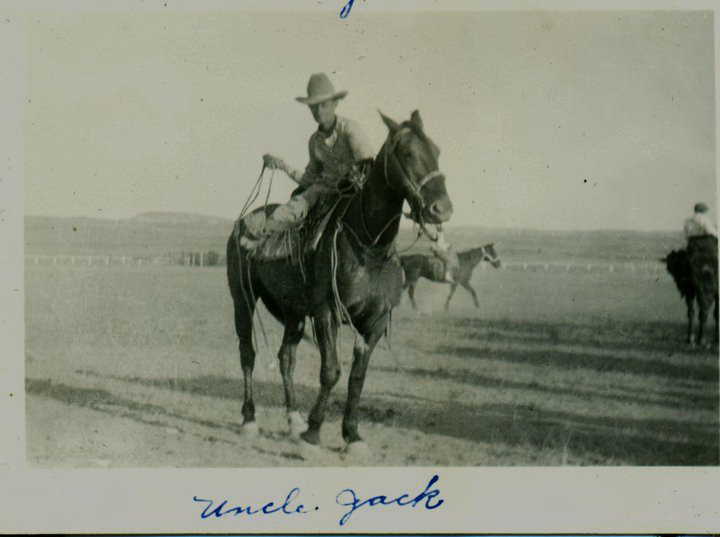
Darn it…I missed out when he was alive! He was born the same year as my grandfather so the possibility exists that I could have known him and not just about him. My great Uncle Jack was quite the person I wanted to know. If he would have lived longer, but he was gone too soon.
The events in his life seem exciting, adventuresome, and risk taking to me. I have researched him and know about him from records and pictures. But…I have never heard him speak to tell his life tales in his own words. I have never met him so as to ascertain his character and demeanor. I have never looked into his eyes so I can study what lies within his spirit.
What I do know is he was a Kansas farm boy who loved horses. He was a real live cowboy in Wyoming. He was the roustabout on an oil field. He was a wagoner in the U.S. Army in World War and stationed in France. He was the manager of a wildlife preserve in Nebraska. He was an arms expert for Remington Arms during World War II, when he died in Colorado. He loved coming back to Kansas and going hunting and fishing with his dad. He died at the age of 46 with cancer. Gone too soon.
He was my grandmother’s big brother, and she adored him. He was a small town acquaintance of my grandfather. As a child and teenager, my mother saw her uncle only a few times. She could tell me little about him. Gone too soon.
My great uncle Jack was born Edward Ralph Boultinghouse in June, 1896, in Osborne County, Kansas, and passed on in May, 1943. Uncle Jack, I have a lot of questions for you. Gone too soon.
Who were the outcasts here? Would their different points of view and political leanings cast them out of the circle? In black and white, it declared which side of the line drawn in the sand a man stood on.
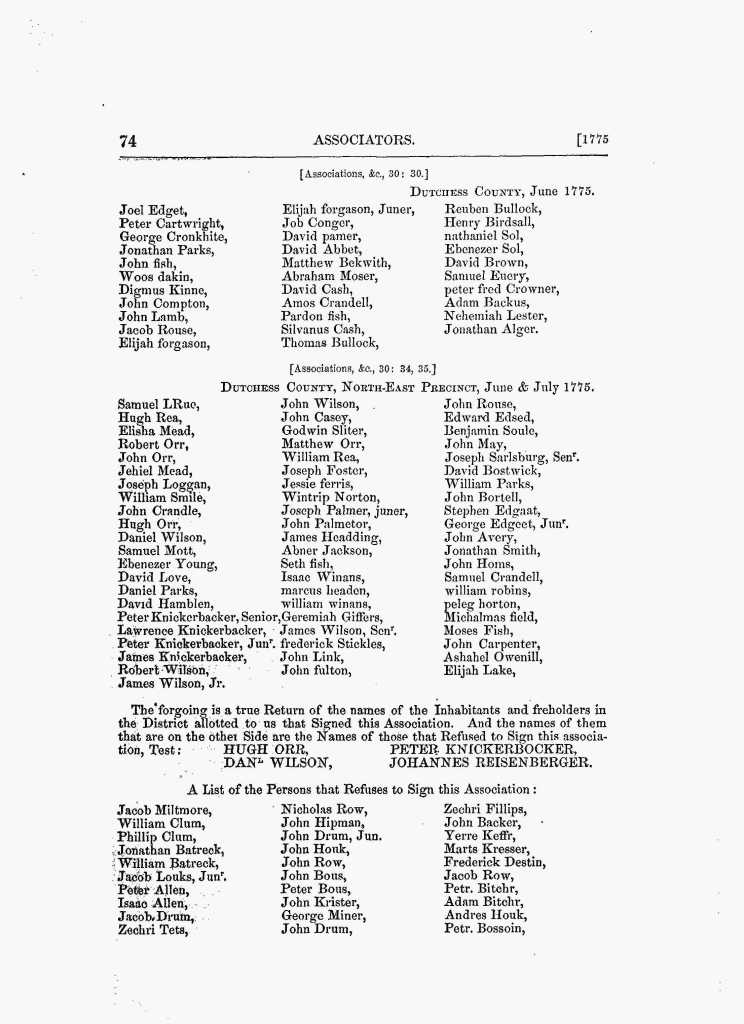
At the beginning of the American Revolution, male citizens were asked to sign an association test: would they side with the Patriots and welcome freedom from George III and Great Britain? Their decisions to sign would lead them down a path of freedom fighting. Also, it was recorded who refused to sign which meant they would remain faithful to George III and his government. Their decisions to not sign would lead them down a path of battle.
My fifth great-grandfather was Benjamin Soule (1728-1779). He signed the association test. He was pledging his life and honor for the American cause. He would not live to see the outcome of the war. He would not live to see how the new nation would rise out of the ashes of that war. An outcast of British citizenry or an outcast of a freedom fighter…
How could an ancestor leave a trail, but yet leave no name? Oops! How could a wife give birth to six children, but yet leave no name? Oops! Yet no marriage records, no recorded place of burial…oops, how could this be?
What it known and what is unknown: Daniel Boultinghouse was born in western Pennsylvania in about 1775. In 1790 as based on the Federal Census, he most likely living with his father in Fayette County. Is he that tick mark for “Males under 16”? Daniel appears in the Scioto County, Ohio, in 1798 along with his wife and four children. His father Joseph has moved there also. His wife’s name is unknown, but the names and birth years of these four children have been recorded. A marriage in either Pennsylvania or Ohio had not been recorded or can be located. By 1802, Daniel and his wife have a total of six children, five boys and a girl. Mrs. Boultinghouse dies in 1802. A son was born that year. Was her death the result of childbirth complications?
Daniel marries two more times. His second wife is Susannah Graves with a recorded marriage on 7 March 1805 in Scioto County, Ohio. She gave birth to five children. She died in 1812. Daniel’s third and final marriage was to Rhoda Howell on 31 January 1813 in Gallatin County, Illinois. She gave birth to two children. Daniel dies in May, 1823, leaving Rhoda with children of the blended family to raise. Her name last appears in the Probate Records of White County, Illinois where she appeared at the courthouse to settle Daniel’s debts. After that date, no records are found of her. Oops! Another of Daniel’s wives disappears.
Daniel and wife Rhoda are my third great grandparents. Military records can be found that Daniel was a Captain of his own regiment during the War of 1812. His mission was to keep the Native Americans from attacking the settlers of Illinois. (That story can be found in an earlier post.)
Unfortunately, the “Oops! factor” played a huge role in keeping these ancestors from being able to come alive to their descendants.
It was not an education I had anticipated. It fell into my lap unexpectedly. When discovered, it called out to me to stare at it straight in the face and determine what I could learn from it. It was an education in the anatomy of a murder.
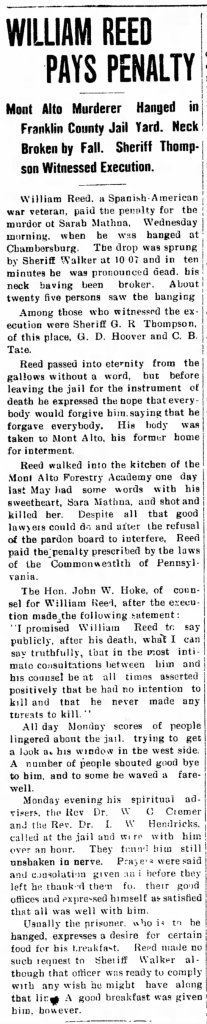
What sparked the education was a death certificate found…cause of death as fracture of the first vertebrae as induced by execution. I sought more information on this case. Newspaper clippings, obituaries, YouTube videos were reviewed. How had this all exploded? Why did he have an implosion inside his brain and emotions?
A year before the murder, Bill and Sadie lived in the mountains near Mont Alto, Franklin County, Pennsylvania. It was 1910. Bill worked for various farmers in the area. Sadie kept house. They lived without benefit of marriage as she was married to a Mr. Mathna who had deserted her and moved west. Bill insisted that Sadie seek a divorce…no, she would not. Finally, the two separated. Sadie moved back to the Forest Academy in Mont Alto where she previously worked in the kitchen. Bill moved back to nearby Waynesboro where he was a laborer at various jobs. As time passed, the two exchanged love letters and pictures. He went every Saturday and Sunday to visit her. Then, the last straw…he discovered she was seeing other men.
Days before that Tuesday morning when he took the train to Mont Alto, Bill purchased a new suit, shirt, tie, and hat. He also slipped something into his jacket pocket. He was going to have his showdown with Sadie. He would ask her for the pictures and letters back. One picture precious to him was his military photo taken at the time of the Spanish American War. He was going to break it off with the unfaithful woman.
As he arrived at the dining hall kitchen where Sadie worked, he noticed that only she was present. She sat grinding coffee. He told her the reason for his visit…he wanted his letters and pictures back. She related that she would go to her room to get them. When she returned to hand them over, Bill noticed that some were missing including his military picture. Again she went to her room to retrieve them. When she entered the room, she threw one of the letters and a picture in the fire of the stove…she picked up the coffee grinder to throw at him. He pulled a gun from his jacket pocket, and she declared that he was too scared to shoot her. Firing and hitting her three times, he proved her to be wrong. She staggered across the kitchen, walked into the dining room, and fell. Bill left…”I have fixed her good” he was heard to say.
Later that day, Bill appeared at the magistrate’s office. While smoking a cigar, he calmly stated that he was the one who shot Sadie. It as not an accident he declared. He meant to hurt her.
At his trial in the spring of 1912, his defense was insanity. He snapped when she made him angry. Throwing his picture into the fire had made him snap. Witnesses came forward who testified that he had threatened to kill her when she was known to have cheated. Jailers testified that he was calm and repentant while incarcerated. Then the case went to the jury…guilty…the sentence would be death by hanging.
William F. Reed was the last man hung in Franklin County, Pennsylvania, on 30 April 1912. Until his death, he asserted that he had no intention to kill nor had he made any such threats to do so. So what about the testimonies of his accusers? Or was Bill delusional?
There they sit…abandoned…forsaken…tossed away. They wait with hope that someone will recognize them and bring them home to their proper places…to be treasured, remembered, and embraced. Why were they left here to await their final fates?
Some of them rest behind stately glass and are enshrined in golden filigree. Some reside in ornate frames. Some are simply tossed into piles or boxes. Some have been regally placed in photo albums. Who will come and claim them for whatever reasons they choose?
As I gaze upon their faces, I wish I could save them all. I wish I could give them the prominent places they deserved. They had been, perhaps, Civil War soldiers who proudly had their pictures taken to send home while they were away. Some are school pictures of children with toothless grins. Some are family groupings of people dressed in their Sunday best. Some are blushing brides and beaming grooms, united to begin new families. At one time, they all belonged to someone who loved them.
Now they sit in antique malls for sale. Customers are invited to claim “instant relatives”. They are now nameless. Who will want them? They seem so out of place these old photos…for sale..forgotten. Waiting for a miracle for them…that someone will recognize them and bring them home.