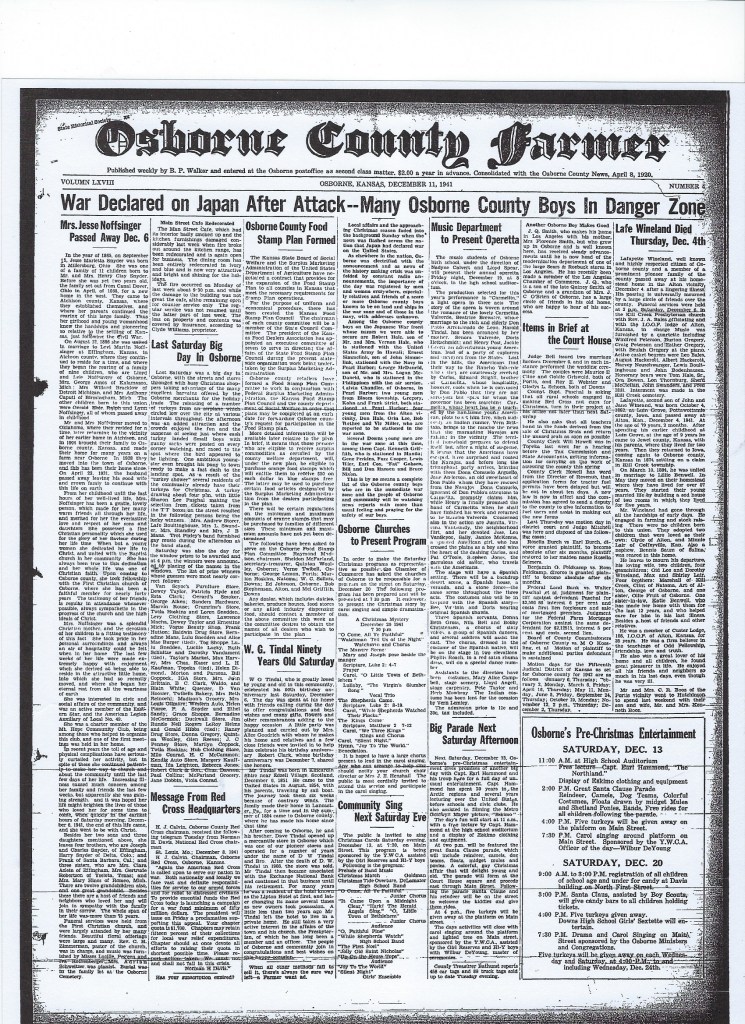
52 Ancestors In 52 Weeks: In The News

Thursday, December 11, 1941

Man In The Street Reaction: Andrew E. Storer, age 45 years old, farmer, Alton, Kansas

“I heard neighbors talking, partyline conversations, meeting friends at the general store…some heard President Roosevelt on the radio as he spoke out about ‘the day of infamy’. Boys will be called up to fight just as I was in 1918. Back then, it was called The Great War…The World To End All Wars. Did the taste of it really end wars? No, now war is in Europe and the Pacific. County boys will respond with loyalty to the freedom of the Stars and Stripes. May God protect them!

Girl In The Street Reaction: Merna Mae Storer, age 17 years old, high school senior, Alton, Kansas

“The school hallways are buzzing with the voices of the boys who are enlisting after graduation. They greet each other with ‘See you in Tokyo!’ As for me, I have been planning on leaving the farm and heading to the state capital in Topeka. As this point, I do not know how war will affect my plans. I might be needed at my parents’ farm. Graduation is six months off so… How can I help? What will I be called to do?”

On this December day, the county citizens’ opinions, thoughts, and prayers varied. They listened to radios at home or at their neighbors hungry for news and reports. They trusted their national and state leaders to guide them forward into the unknown abyss of another war. Little did they know that it would end four years later with many county boys giving their lives for freedom.

Note: Andrew E. Storer is my grandfather who served in World War I. Merna Mae Storer is my mother who after high school worked at the State Capitol Building in Topeka. In that city, she would meet her future husband, Edward J. Slabik, who came for Army training in Topeka.

52 Ancestors In 52 Weeks: Birthdays

September 24, 1900: Birthday Surprise on Mrs. James Nickel

It seemed that husband Jim was going to pull off the perfect surprise for his wife Mary Emily. It was her 50th birthday, and a big afternoon was planned. Jim was being secretive. He invited family and neighbors to come for a surprise supper for his wife of 29 years. Would he get away with it?

Through word of mouth, invitations went out. Guests were asked to bring a dish to share plus bring their own plates and eating utensils. Daughter Almina was baking a cake to bring. They were to assemble at noon. So when vehicles began to arrive, Mary Emily gasped in surprise at the company. “Jim Nickel, what have you done?” she questioned. “Nawthin'”, was his response.

All the little details of the day were reported by the small weekly Kansas county newspaper, The Osborne County Farmer. Such a little event merited eight paragraphs. As was typical of the social event reporting of the day, the article touted the couple as “good people and have raised a good family and made a good home.”

James Nickel and Mary Emily Weaver are my second great grandparents. I never heard anyone speak of them. I first met them in a county history book. In investigating their lives, I used that same county newspaper to flesh them out as real people. Amazingly, little social gathering details were reported in that newspaper. I was able to meet them and get to know them. They were pioneers who first came to Osborne County, Kansas, with their family in 1878. Jim was from Pennsylvania while Mary Emily was from Ohio. And so, a little surprise birthday party became an avenue of making their acquaintances.

Cherished Forever

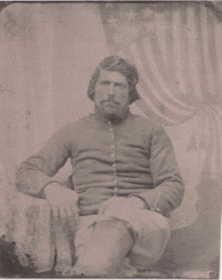
The warm breezes across the farm fields whispered his name…”Abel, gone, gone”. It was the summer of 1864. Eliza Ann had to hold the family together because her beloved Abel was not coming back. As she looked across the Franklin County, Maine, fields, she could hardly hold back the tears of grief. Such sadness for one heart to hold!

He was 20 years old, and she was 17 when they married. In the 18 years of their marriage, they parented 8 children. The land they farmed could hardly support them as they relied on charity. So why did he enlist in the 2nd Maine Cavalry in January, 1864? Was the cause calling him to action?

Before he left, he has his likeness taken. Proud in his uniform. Proud of his military contribution to county. Proud of his heritage dating back to his ancestors of the Revolutionary War. Proud to be in the cavalry. He was going far from home to help protect a city he knew little about, but he had been called to serve.

Abel was stationed near New Orleans to protect the city. Beginning in April, 1864, he had complained of heart pain and asked to be placed in the field hospital. The Army surgeon diagnosed him with rheumatism and placed him back on duty. On May 26, when his regiment was leaving the city, Abel fell from his horse and died. He had endocarditis, a heart condition. He was buried in Louisiana.

Back in Maine, Eliza Ann received word of her Abel’s death…gone in Louisiana. She wasn’t sure where that was. Buried…she wasn’t sure where. Never to see him again…how would she survive?

Through time, Eliza Ann took in boarders to support the family. She applied for a widow’s pension which was granted in 1865 in the amount of $8/month. She never remarried and lived 43 years without him. Did she ever journey to his burial place so far from home?

Note: In looking over my tree, I first noted Abel’s Civil War likeness and his death date. I became curious as to his story. In researching him, I found these facts about him. He lies buried in Chalmette, Louisiana, National Cemetery. Did Eliza Ann ever get to visit his resting place?

52 Ancestors In 52 Weeks: FAST

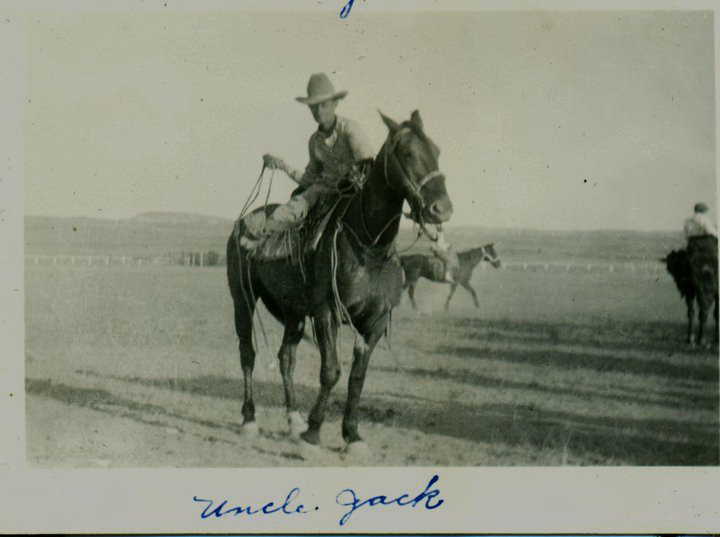
FAST…Fearless, Adventuresome, Self Confident, Thirsty…Uncle Jack comes to my mind. Never knew him, never interviewed anyone who knew much about him. He remained a mystery until I found him softly mentioned in a weekly newspaper. The mentions were dribs and drabs until I put them all together to paint a picture.

Fearless…Jack was ready to take on any challenge directed his way. He left Osborne County, Kansas, at the age of 24. He learned the love of hunting and fishing from his father. There was nothing to keep him interested in his small town. He needed action. He had been to France during World War I, where he had been a supply wagoner. He had found that thrilling. He needed to move on.

Adventuresome…Jack left Kansas. He headed to Natrona County, Wyoming, where there were oil fields. He chose to be a roustabout, a laborer to get supplies and equipment for the oil drilling teams. During the offtimes, he worked on a ranch. He loved to handle horses. When the time was right, he could hunt and fish. He married and had a daughter. Jack was impatient and thoughtless so the marriage did not work out.

Self Confident…Jack knew he could handle any job that involved animals, rifles, nature. He left Wyoming and headed to Nebraska. There he became the manager of a wildlife preserve. He enjoyed being his own boss. He loved taking care of wild animals. He remarried and planned on settling in.

Thirsty…Jack longed for an even greater challenge. Through the years, he had become an expert on Remington Rifles. World War II demanded that the American Army have topnotch rifles. Jack was recruited by Remington to come aboard their design team in Denver, Colorado. Under the veil of governmental secrecy, he worked. During the middle of the war, Jack developed brain cancer. When he was hospitalized during his final days, his room was guarded. Officials were afraid that the painkillers given to him would make him delirious…he might reveal secrets.

Jack was my great uncle. His full name was Edward Ralph Boultinghouse (1896-1943). I became interested in his story when I was given his World War I dog tags. And so…

52 Ancestors In 52 Weeks: Last One Standing

Born during the Civil War…died after World War II. When she entered the world, Abraham Lincoln was the president of a divided nation. When she left the world, Dwight Eisenhower was the president during the time of the Cold War. At the end, she would be the last one standing of her parents and siblings.

A child of the Illinois prairies, Helen Boultinghouse was born while her father had recently left for war. He would return when she was a toddler. Her babyhood was spent with her French mother on the family farm along with seven siblings. She knew the security of family bonding together for the sake of survival. What character traits would be gifted to her at this impressionable time of development?

At the tender age of nine years old, her parents felt a call to move the family to Kansas. Gathering up family and possessions, they went by wagon train to make their new home in Osborne County, Kansas. What experiences in being a child pioneer were felt most by her?

At the tender age of 18, Helen married 35 year old Willard Comer originally from Canada. They married in June, 1880, in Russell County, Kansas, where they remained for the rest of their lives. How did they met, and was this a love match or marriage of convenience?

During their marriage, Willard was a real estate agent…Helen’s background was farming so town life was new to her. Two daughters, Pearle and Brownie, completed their family. They lived ordinary lives until Willard became ill. He suffered for three years and was bedridden for the last year. Not only a wife and mother, Helen was a devoted caregiver. He passed in 1916. How did it feel to be a widow at age 54 in a small Kansas town?

For the next 34 years, Helen was alone except for her daughters who remained at home and never married. The world around her was constantly changing, not only nationally but also for her personally. Her parents and siblings were now gone…last one standing. What did she tell herself to make these losses lessen and the grief bearable?

Helen Boultinghouse was my great grandaunt. I never heard anyone speak of her. I could not find much written about her. Today I discovered her and brought a part of her story to light. So, Aunt Helen, what else would you like me to write to bring your memory alive?

52 Ancestors In 52 Weeks: So Many Descendants

And God made a promise to Abraham: He said, “ I will give you this land for your descendants. I will make you a great nation, and I will bless you. I will make your descendants as numerous as the stars in the sky.” And so it was.

And through time and generations, this became true for others. A girl born in New York in 1833 would see this promise fulfilled in her and her descendants. Her name was Mary Etta Soule.

Mary Etta, like Abraham, would travel far from her birthplace to her final destination. After the death of her father when she was 14 years old, she went with her remaining family down the Erie Canal, across Lakes Erie, Huron, and Michigan and then to the newly formed state of Wisconsin. They caught a grain wagon to Watertown, Wisconsin. What drew them there? Destiny…fate…God’s plan? For awhile, her mother Jane was the only adult female in the area. Native Americans camped near them but left them in peace. From her mother, Mary learned to be resilient and strong willed.

At the age of 19, she worked for Andrew Storer who managed a brickyard. Her brothers were also in his employ. Andrew was a widower originally from Maine. He, too, set out to find himself far from home. They wed in 1852 in Wisconsin. Wanderlust would take hold of them and lead them on to their final home in Osborne County, Kansas, twenty years later.

A home at last…settled…established…part of a community…matriarch of a family. Mary Etta spent her days in relative domestic happiness. Under the prairie skies and stars, the promise to her of many descendants was unfolding. When she went to meet her God in 1887, she could tell Him, “Yes, as many as the stars.”

Mary Etta Soule and Andrew Storer are my second great grandparents…I am counted among their stars.

Note: This is my 175th blog about my family and their history.

52 Ancestors In 52 Weeks: In The Cemetery

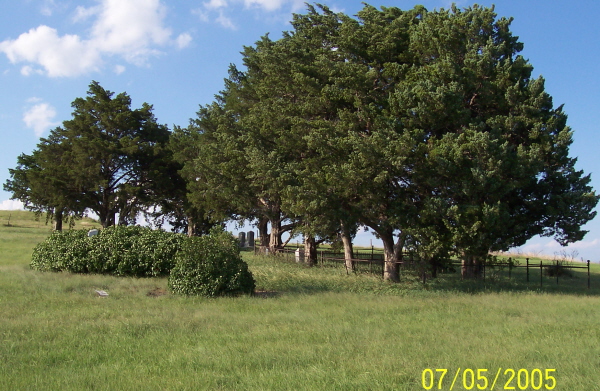
Intertwined among the branches of my family tree lies a story. It is a remembrance of how grandparents helped grandparents find a place of eternal rest. They were neighbors from a farming town…Bloomington, Osborne County, Kansas. Like all good neighbors, they cared for one another.

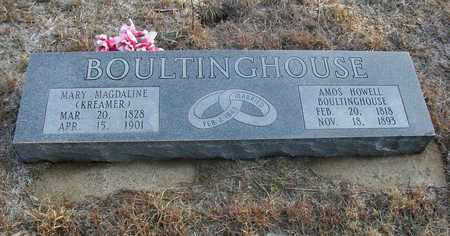
When Amos Howell Boultinghouse died in 1893, the Civil War veteran was placed in an unmarked grave on a piece of land near Bloomington. When his wife Mary Magdalina Kraemer passed in 1901, she was placed beside him. Family members would say, “Grandpa and Grandma B are buried near the fence.”

More than 50 years later in 1944, Amos’s son Lafayette Boultinghouse become aware that the U. S. government provided markers for veterans. Paperwork and proof of military service had to be provided. When approved, the marker would be shipped to the veteran’s family. On a fall day, Lafayette meet the train to receive the tombstone…”Amos Boultinghouse…55th Ill. Inf….Gone”. His grave was located near the fence and the footstone laid to rest with Amos.

When Mary died, there was no marker for her. She lay unknown for over 80 years. Her great great grandchildren who lived in the county had a reunion in the 1990’s. They decided that Amos’s and Mary’s grave would be located and a proper tombstone installed for them both.

Finally, Amos and Mary had their resting place honored.

Amos and Mary are part of my Grandmother Isabella Boultinghouse’s story. It would be her husband Andrew Earl Storer’s family that added to the story. In 1900, Wash and Sarah Storer (my grandfather’s parents) sold 5 acres of their farmland to the Bloomington Cemetery Association. The cemetery was to be laid out in plots, drives, and paths.

May all who rest there be honored for their contributions to the communities that they loved and served.

52 Ancestors In 52 Weeks: Brick Wall

Dear Grandma Rhoda, You remain a mystery to me with little trace of your footprints left behind. How could you just vanish? What became of you after the death of your husband, Daniel Boultinghouse?

You left behind a marriage record and a visit to the county probate court. You survived your husband’s leaving for duty during the War of 1812. At that time, you cared for Daniel’s children from his first two marriages. You named your son Amos after your father. Your children were nine years old (Matilda) and five years old (Amos) at the time of your husband’s and their father’s death. That’s it…I have hit a brick wall.

I will be checking the 1830 Census and beyond to see if you are a tick mark on a stepchild’s entry. I wish you could guide me to more information about you. I want to draw out more details so I can paint a clearer picture of you and your life. I wish…I want…I hope.

Love, Your Granddaughter

Note: Rhoda Howell was my third great grandmother, married to Daniel Boultinghouse. It is speculated that she was born in Tennessee… unknown year in the 18th Century. She married Daniel on 31 January 1813 in Illinois. Her year of death and place of burial are unknown. Women at that time in history left little in the way of paper trails to follow. I wish…I want…I hope.

52 Ancestors In 52 Weeks: Bald (Faced Lie)

How did she keep her secret so hidden? It had to be obvious to what the true was. It was actually a bald faced lie. The convent educated bride was claiming an untruth in front of a priest and county clerks.

Maria Magdalina Kraemer migrated from the Alsace-Lorraine region of France. No ship manifest has come to light with her name as a passenger. Parentage unknown. Year of emigration unknown. Residence in Manhattan unknown. A mystery left to the ages.

Educated by nuns in a convent school, Maria excelled in needlecrafts and sewing. Somehow she met an Army private from Illinois who was stationed at Fort Columbus outside of New York City. How were these two introduced? How were they chaperoned during their courtship? Why did she agree to marry and be relocated to the plains of Illinois? The year was 1843, and Illinois had been a state for less than 25 years.

The bald faced lie: on her marriage license, she declared that she was 22. In reality, she was 15. With the declared age of 22, a parent’s or guardian’s permission and signature were not required. Did she try to conceal her real age somehow by dressing to look older? Did she have no guardian to stand up for her? A mystery left to the ages.

Together, Maria and Amos Howell Boultinghouse shared 50 years of marriage. They were the parents of eleven children. Married less than 20 years, Amos would reenlist in the Union Army. They would be parted by the Civil War with Maria running the farm. After the War, they would move onto Osborne County, Kansas. They are my second great grandparents.

Some might say that nothing good can come from a bald faced lie. Perhaps, there are exceptions.

52 Ancestors In 52 Weeks: Pet (Project)

Deciding to travel around the country, my cousin Melvin Storer was a one man family history information gatherer. He started in the 1970s after retirement with just a notebook and a pencil. No computers, no Ancestry, no Family Search…just himself, his organizational skills, and a notebook. He was going to put together a family tree using his own research skills.

Locating as many cousins as he could, he mailed out questionnaires to them…102 questions that covered all the basic facts plus hobbies, occupations, locations of other cousins. When he received word of another unknown to him cousin, he sent a letter and form to them. He was devoted to the finding of family members.

When he could, he would fly to various cities in different states to do one-on-one interviews. He figured he got to see different parts of the country to meet his relatives. He did this for several years and piled up bonus miles for the purchase of the next ticket. He carried all his research in a briefcase that was his companion on each flight.

One day, he was headed out on another flight accompanied by that briefcase. He left the briefcase by his chair in the lounge and wandered up to the window to order a snack. When he came back, the briefcase was gone..stolen…all his records and notes taken. Melvin suddenly lost all desire to continue with his journeys and research. Along with the briefcase, his zest for discovering family history was stolen.

When I decided to do family history, I took along the spirit of my cousin Melvin. Using a computer, Ancestry, Family Search, and various vital state records, I would find those cousins along with grandparents, uncle, and aunts. DNA would also introduce me to more cousins. I would piece together a tapestry of family history. Melvin would be proud to know I found from the Storer line our 9th great grandfather who was a passenger on the Mayflower. Here’s to you, my dear cousin…I inherited from you a passion for family history.