52 Ancestors In 52 Weeks: Free Space

About 40 years ago, it was a simple meeting. Brief introductions were made. She was the mother of a friend who lived at the beach. We were sitting in chairs near the water and savoring the cool breezes coming our way. So, this was my friend’s mother…Miss Julia.

Miss Julia spoke in those soft, Southern tones that declared she was a lady. She was carrying a big brimmed straw hat that stated a lady needs to protect her face from getting freckled. She sat down, joined us, and turned to declare, “I have finished my book.” At that time, I was a professional writer so her declaration really caught my attention.

Miss Julia had been working on a family tree and writing individual stories on her ancestors. This interested me since this family history writing was new and unfamiliar to me. So, I asked her, “Miss Julia, may I read your book, please?” Reverently she handed me the notebook binder of stories.

As I sat on the covered porch in a rocker, I met the most interesting people. Her family were true Southerners…delightful, warm, friendly, various jobs devoted to service of others. I spent a delightful afternoon in the company of Miss Julia’s family.

Little did I know or Miss Julia either…she planted a seed that day: a flower that would grow to fruition in 20 more years. That’s when I discovered Ancestry and how to put a tree together. Then it would lead me to Amy Johnson Crow who would mentor mein her 52 Ancestors. The family storytelling has and will continue to come full circle. Thank you, Miss Julia.

52 Ancestors In 52 Weeks: Boats

24 May 1906 Ellis Island, New York City

This all started with a dream. This all started with letters. This all started when my brother Antoni set it in motion. This all started when I left my village with four companions. This all started when we walked and took trains from Poland to Italy. This all started…

At the beginning of this dream, letters came from Antoni in America. He begged me to join him. He had sent a ticket in a letter for my older sister Katarzyna in 1902. Now it was my turn to meet them. I had to memorize the contents of the letters since I could not read nor write…my parish priest read them to me. A ticket and American money came for me…for me!

In the letter’s instructions, I was to walk and take a train to Trieste, Italy. I knew nothing of this place. Where was it? I would be accompanied by four others from my village. I was told to pack my possessions in a blanket and bind it up so I could carry it. Actually, I had so little. I made a packet of food. I was ready to start my journey to the unknown.

When we arrived in Trieste, I had never seen such activity of big ships and so many people. I heard all kinds of spoken tongues. I noted people of all ages. My companions and I held hands so we would not be separated from one another. We had to answer many questions so that our answers could be written down. I was told by my brother to state my age as 16…I was actually 14. Our ship’s name was the Georgia. We were to be in a part of the ship called the steerage. The golden day to start our journey was 30 April 1906.

In steerage, we were given food rations and were expected to prepare our own food. We crowded into bunks for sleeping and kept an eye open on our bundles. When we cried, we comforted one another. All these strange people, all these strange tongues, all these strange smells. We looked forward to the times we could go on deck and breathe the air. In just 25 days we would be in this place called New York City.

In his letters, my brother had told me to look for the Lady in the harbor. When I saw her, I would know that I was in America. I would soon be able to depart the ship and take a ferry with other passengers to a place called Ellis Island. There we would be examined by doctors, prodded by officials, questioned by workers. If I passed all these stations, I would be released to my waiting brother. I would walk down the Stairs of Separation, and I would take the aisle to the left for those going to New York and New England. We would be going to a place called Connecticut where I would be employed as a scrubwoman at a residence.

As I sit here on a bench in the Great Hall at Ellis Island, I am waiting to hear my name called. My companions and I are shedding tears since we will be soon parted. We are all headed to different places from one another…Philadelphia and Jersey City. Will we ever see each other again?

Here I sit on 24 May 1906…a day that I will forever remember…on a bench waiting. Finally, I hear it…”Anna Mroz”. I have been called forward…and so the rest of my dream begins.

Note: Anna Mroz is my paternal grandmother. So young…so brave. How long she resided in Connecticut with her brother is unknown to me. A few years later, she would relocate to Philadelphia. There she would become sweethearts with her Polish neighbor, Franciszek. They would be married on 3 October 1914.


52 Ancestors In 52 Weeks: Automobiles

April 3, 1910 Bloomington, Osborne County, Kansas

Dearest sister Clara Dell,
Oh my stars, I am so excited. I utterly cannot believe it. It’s like a fairy tale story. Husband Wash announced to the family at Sunday dinner that he is buying an automobile. How will this change our lives here on the farm? What does this actually mean? I just have so many questions.

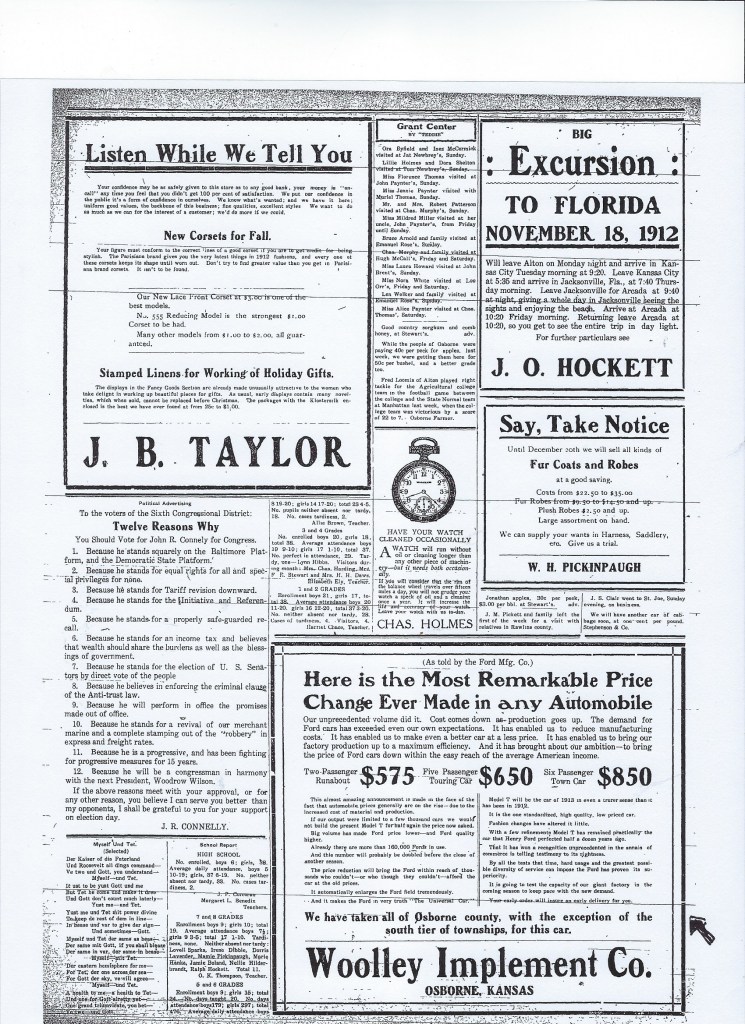
Wash said it all started when he went into town one Saturday, and friends at the elevators started debating about the merits of owning an automobile. Pros, cons, and personal opinions were tossed all around. Someone stated that going over to Wolley’s Implements to see an actual automobile might be worth the trip. Who was interested in going along?

Wash went along with questions. Questions about operating it, maintaining it, paying for it were some of the queries. Did he think he could actually drive it because it was certainly different from taking out a team of horses and a wagon? To him, there was a lot to consider.

Finally, he said, he wanted to surprise us all at family dinner. Buying the Model T could change how often the family went into town on a Saturday. It could change getting to church. Why, they all may have more time to visit neighbors. I just thought to myself how blessed we all are. To me, I would feel less isolated as a farm wife…I could see and visit more folks.

I have to confess my sister-in-law Hattie asked me why I did not question Wash about the decision being made without me. Frankly, it is not of her business plus I trust him to make good decisions for our family. Enough said.

In the meantime, Wash needs to have Mr. Woolley’s men give him driving instructions before we take delivery. I cannot wait…I feel this is going to change our lives.

Love from your sister,
Mina

Note: Sarah Almina Nickel and Washington Irving Storer are my great grandparents. They had 8 children who were all still at home in 1910. So a total of 10 people got to feel the changes that the purchase of this automobile brought.

52 Ancestors In 52 Weeks: Trains

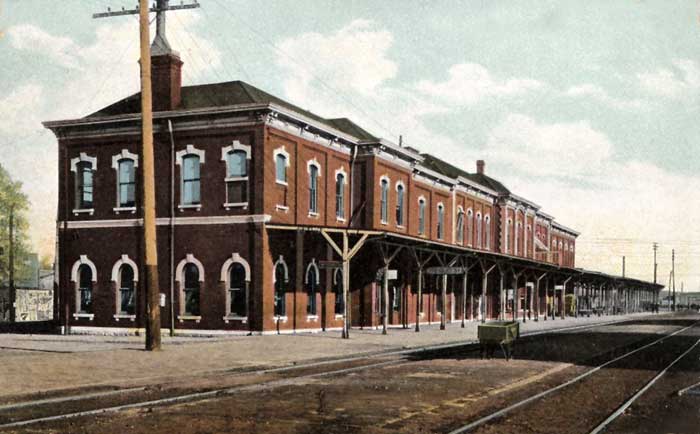
Train Station in Topeka, Kansas

Spring, 1946 Topeka, Kansas

Am I crazy? Have I thought this all through? Am I certain that my decision is what I want? Will it all work out according to my dreams of a future?

Well, my folks think I am gambling on a promise. They do not like that I am moving from the land that I know to the unknowns of a large bustling city across the country. My wartime roommates think it is romantic. We all had jobs at the State Capitol. My gal pals Marge, Maxine, Edith, and Phyllis are all planning to meet their guys back from the war right here in Topeka as they plan their new lives together. Me…I am headed to Washington, D.C., to a secretarial job with the Department of the Navy. I will be living in a women’s apartment building with other gals working for the government. There, I will meet Eddie, who has taken a job with the Signal Corps.

In Topeka three years ago at a dance at the American Legion, I met Private Edward Slabik who was in training before he would be shipped out. We saw each other several times, and we had written back and forth during his time in combat in the Pacific Theater. Those letters contained many dreams and plans. Would all these words and promises come true?

So, all on my own, I planned how to get from Topeka to Washington by train. I had memorized the places I will switch trains. I have packed and unpacked my one suitcase. Finally, I have gotten my folks’ blessing. I will be leaving tomorrow…21 year old me as I am ready to meet my destiny. May God be with me.

~Merna Mae Storer

Note: Merna Mae is my mother. She claims she knew my dad for five days before he left for war. My dad claims they knew each other for two whole weeks. They married in Spring, 1947. They would be together for the next 60 years.

52 Ancestors In 52 Weeks: Planes

8 August 1958 Philadelphia, Pennsylvania

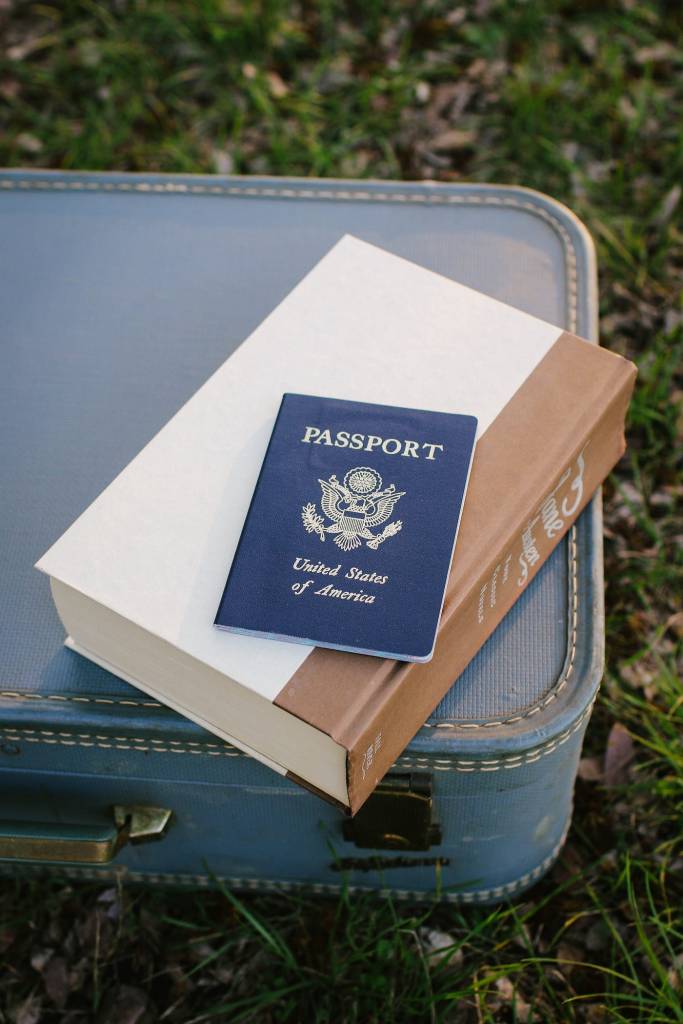
Reverently, he touched the airline tickets and passport on his dresser. He had not been home in nearly 50 years. Whom would he know when he finally arrived? Who would rush out to hug him? For that trip back to his homeland, he would go alone just as he had come here to this land…alone.

This trip would be different from his first: he had come here by ship with a ticket in steerage. He had little money in his pockets. Now for this excursion, he would be flying with a ticket in coach. He would be carrying travelers checks to pay for all the souvenirs he planned to bring back.

In just a few hours, he would arrive in New York City at Idlewild Airport to take the first leg of his journey back to his native country. His daughter and grandsons were taking him to see him safely off with best wishes for safe travel. He had never flown before.

Reverently, he opened his newly obtained passport and read his name: Frank Slabik. He saw his picture…my, how he had changed in that almost 50 years. Back then, he had recorded his name on the ship’s manifest as Franciszek Slabik. He was an American citizen now as his passport stated. He would be returning to his native country of Poland.

In just a few hours, he would be boarding a KLM airlines plane with flight to Amsterdam. He would make a connection and land in Poland. In the time he had been away, his beloved motherland had suffered from two world wars. Would anyone and anything look familiar?

As he descended the staircase of his daughter’s home, he carried his suitcase along with the precious tickets and passport. It was time to leave for Idlewild and the city. Just as he left Poland in 1912, he felt that same anxiousness now…that same longing for the traveling to the unknown. He was taking his first flight…a flight back to his family and roots.

Note: My grandfather Frank Slabik went back to Poland in 1958 for a visit to his hometown in the Carpathian Mountains. He reported that he gloried in the telling of his life in America and in his adopted city of Philadelphia. It brought tears to his eyes in the relating to us about his trip.

52 Ancestors In 52 Weeks: Family Gathering

The gentle prairie breeze sifted through the air as it cooled all the picnickers. The cottonwoods shaded them and protected them from the harsh sun. Under her watchful gaze, the family gathered to tell tales, recount heroic deeds, and bring their loved ones back to life.

The Boultinghouse family was gathered in the Bloomington Cemetery on a Sunday in July 1916. Three of Amos and Mary’s children and their families were present: Helen, John, and Lafe. They had chosen to gather here to honor their parents, who laid in unmarked graves. “Grandma B is buried by the fence,” Helen stated. John shared with the children stories he had heard this father tell of fighting alongside General Sherman in the War of the Rebellion. Lafe bragged about his being the first white male born in Osborne County, a few days after his parents had made it by wagon train from Illinois. Stories were shared about Grandma being French and marrying her 25 year old groom at the age of 14…she had lied about her age. The adults talked among themselves while the children ran across the fields.

Under her watchful gaze, the family continued to picnic and talk.

The time came for the party to gather up quilts, food baskets, pillows, and other items. In a circle they stood and prayed, ever thankful for their parents and grandparents lying at rest there.

Under her watchful gaze, the family left the hallowed grounds. The silent sentry in the form of an angel stayed behind to bless and guard the souls buried there.

Note: Amos and Mary were my second great grandparents who died in 1893 and 1901. Amos’ grave lay unmarked until 1944, when the Veterans Administration provided markers for veterans. Mary’s grave would be marked after 1990 by family members who wanted a tombstone for the couple.

They were buried in Bloomington Cemetery in Osborne County, Kansas. In 1910, Wash and Almina Storer donated the land where the Boultinghouses were buried to officially designate it as a cemetery. The Boultinghouse and the Storers would then make a connection in 1922. Isabella Mary Boultinghouse, daughter of Lafe and Naomi, would marry Andrew Earl Storer, son of Wash and Almina.

In those years before recreation parks and spaces, families would picnic in cemeteries. It was not unusual for folks to meet for family gatherings…nor for silent angels to keep watch.

52 Ancestors In 52 Weeks: Storyteller

I am the storyteller.
I am the storyteller who searches for my ancestors in records.
I am the storyteller who resurrects their voices.
I am the storyteller who narrates their individual tales of victory and struggle.
I am the storyteller who fashions their thoughts on paper and fleshes them out.

I am the storyteller who accompanies them in their immigration passages to America.
I am the storyteller who stands with them at Plymouth Rock and on Ellis Island.
I am the storyteller who walks with them to new lands to settle and homestead.
I am the storyteller who passes on their struggles with nature and illnesses.
I am the storyteller who maps out their migration across this new country.

I am the storyteller who passes them ammunition as they stand with Washington during the Revolution and the creation of a new republic.
I am the storyteller who witnesses their battles of brother against brother during the War of the Rebellion.
I am the storyteller who marches with Doughboys in The Great War.
I am the storyteller who stands with young men in battle fatigues in World War II.
I am the storyteller who cries over losses in the Vietnam War.

I am the storyteller who has been entrusted with their hearts, souls, and minds.
I am the storyteller who will continue to see them in my mind’s eye and hear them in my heart.
I am the storyteller.


52 Ancestors In 52 Weeks: Hard Times

21 June 1897 Minnehaha Falls, Minnesota

Hard times have befallen me so I reached out for the best help I could get. As I sit here on the porch in a rocking chair, I can spy the mighty Mississippi River. As the river ebbs and flows, it reminds me of the ebbs and flows of my varied life. I am an inmate at the Minnesota Soldiers Home.

Let me start at the beginning. Born in New York in 1830, I settled in the new states of Wisconsin and Minnesota with my mother and siblings. I was 19 years old in 1849. It was a hard living as my mother and sister were some of the first women in these states…not much civilized. We farmed, we worked in a brickyard, we counted every penny for our existence.

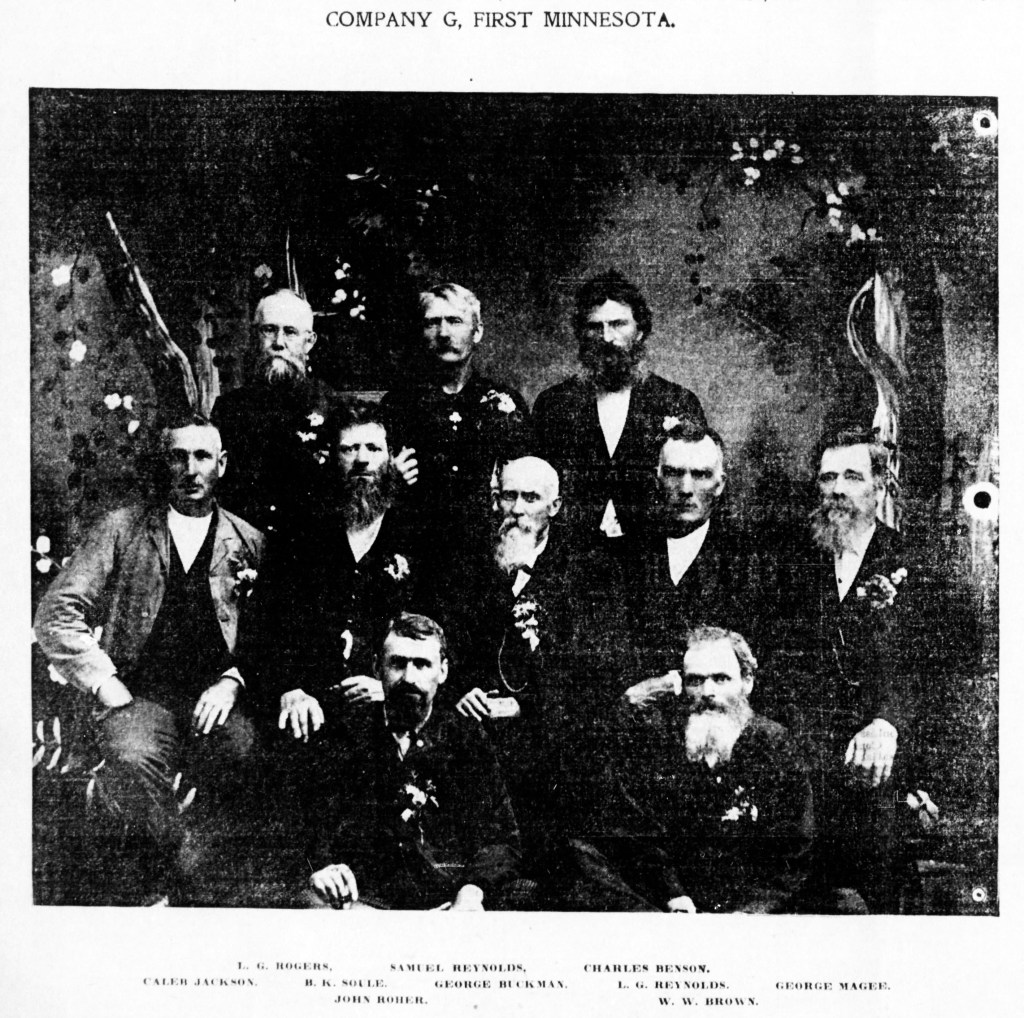
We came to Minnesota in 1855, and I lived a quiet life on the farm. My world would change in six years time. My experiences would reset my life and all its then dreams. In 1861, I enlisted in the First Minnesota Infantry, Company G. It was the start of the War of Rebellion. I was 31 years old.

Letters home to my mother told of what I saw although I did spare her of telling the worst. I had no sweetheart so no letters to write to a dear one. In September of 1862, I witnessed and participated in a terrifying battle where many were lost. At Antietam in Maryland, I was wounded; but my wound was minor so I was placed back in the Company. Three months later, I was wounded once more at Fredericksburg, Virginia. My wound was serious…I was disabled. I was sent home in February, 1863…I was a war hero to my family. I would not march with my brother soldiers to Gettysburg that coming July.

Back home, I managed to support myself by farming as I was able to secure land. I had no family, no wife and children for helpmates. I hired out farm hands. For awhile, I also drove a stage and carried the mail. Finally, my disability landed me on hard times.

Last year, I came to know the Soldiers Home…a place for displaced veterans. I get to live out my days in the company of old soldiers like me who have stories to tell. In my room. I keep a photograph of a “once upon a time, I went to a veterans reunion”. And so…hard times gave me a place to find rest and peace.

~Balthus Keefer Soule, Minnesota Soldiers Home

Note: Balthus was my second great uncle. When I came across his reunion photograph, it prompted me to research his life. I was unable to find exactly what his wounds were at Antietam and Fredericksburg. Obtaining his military pension record will shed light on this aspect of his story. When I have the rest of the answers, his story will be further told in a later blog.

52 Ancestors In 52 Weeks: Health

2 June 1946 Bloomington, Osborne County, Kansas

Staring outside the farmhouse window, I am numb. I can see the windmill, barn, and the other outbuildings, but I do not see him coming in from the fields. Where is he? His hat and coat are hanging by the door. Where is he? Then the terror and panic grab my heart. He is gone…he is not coming back.

I settle into a chair and try to think, to focus, to recall. I remember the sheriff speaking to me in solemn tones and telling me that my husband Wash was no longer living. I faintly recall my children and grandchildren coming to take care of me. I can hear in my mind the minister speaking of God’s love as we sat in the church and went to the cemetery. My mind simply cannot comprehend…where is he?

Looking back, I can hear the doctor’s words as we went together for Wash’s health exam. “Mr. Storer, you have Farmer’s Lung. It is a breathing disease with no cure. We have some medicines to keep you comfortable. You best give up farming.” I thought to myself, “Heavens to stars, this is a death sentence. How can that be?” Then, my mind totes me back to the present. Just where is he?

My children and grandchildren are urging me to protect my spiritual, mental, and physical health by leaving the farm. My dear Wash died in the kitchen…he wanted to spare me his suffering…he took his own life. My soul just cries out…where is he?

I have decided that I will move away from Kansas. One of my daughters lives near Los Angeles, California. It will be sunny and warm all year round…no more brutal winters…just sunshine. Perhaps this last part of my life, I will be blessed with kindness, love, and caring. I will take my precious Wash with me and live in good health for the both of us.

~Sarah Almina (Nickel) Storer

Note: Sarah and Wash are my great grandparents. Sarah was born in Ohio while Wash was born in Iowa. Their families moved to Osborne County, Kansas, in 1871 and 1875. They met and married in 1891. They were married for 55 years.

52 Ancestors In 52 Weeks: Creativity

July 26, 1935 Bloomington, Osborne County, Kansas

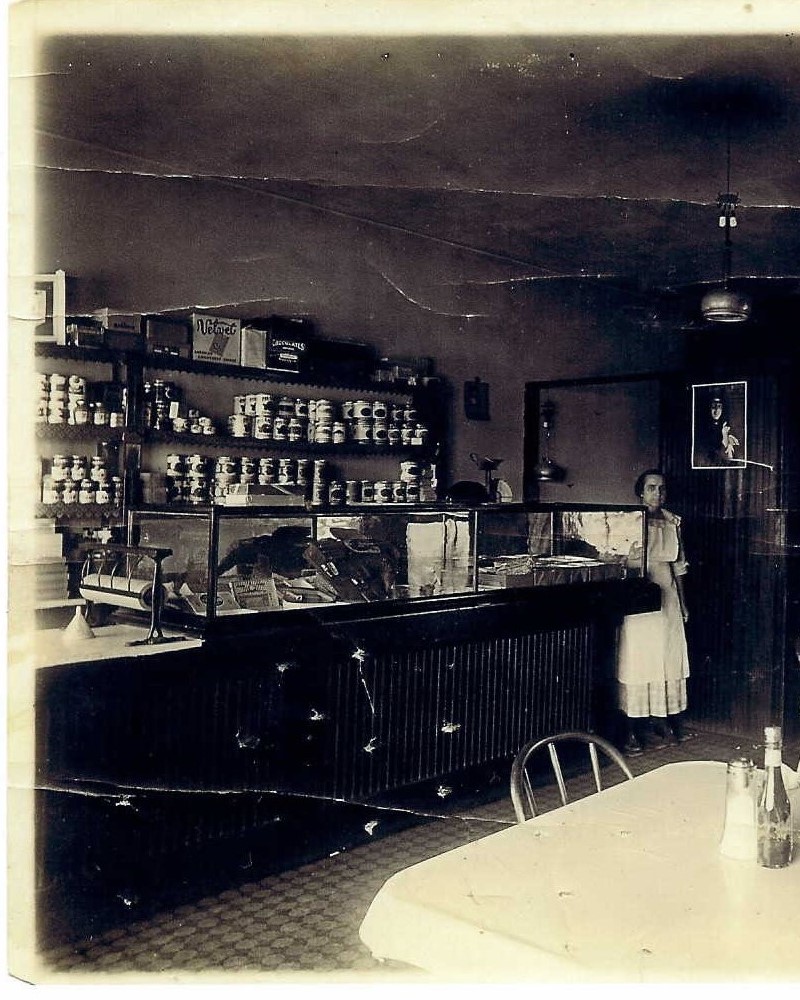
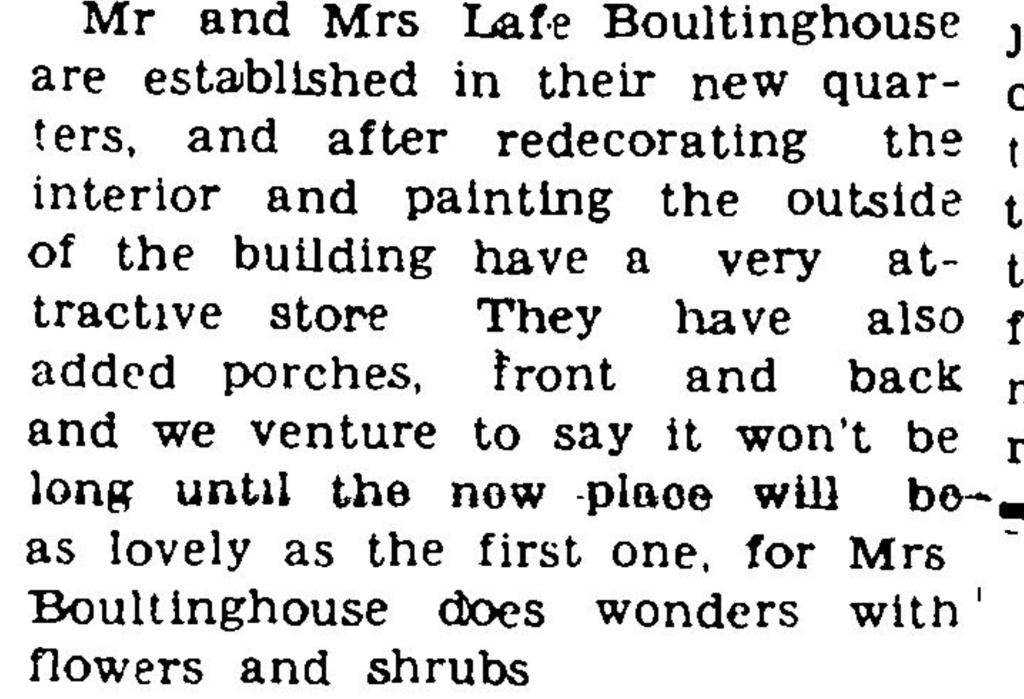
Between my husband Lafe and I, we have managed to rise literally out of the ashes. More than three months ago, we attended a family funeral. When we arrived home, our store and home were in flames. Everything was lost.

So many things are happening at once here in Kansas…the Depression along with Black Sunday when huge winds moved millions of tons of soil across the southern part of the state. We are calling it the Dust Bowl. We are losing some of our family who are moving onto California and Oregon. Now this: unknown men set fire to our store and house. Everything is lost.

One blessing that is helping us rise is the two of us have the ability to make something new out of this loss and mess. Lafe is an excellent carpenter. In his hands lies the talent to build us a new store and house. In my hands lies the talent to sew, plant, and paint. As he builds, I sew curtains and quilts…as he makes furniture, I paint walls…as he creates store shelves, I plant a yard full of shrubs and roses. Folks have remarked on our creativity. We have remarked on our blessings. All is not lost.

So in a few days, we shall rise and welcome customers to our new store. I will continue to welcome townspeople to my cafe inside the store. Our creativity will have helped us rise. All has been found.

~Naomi Ruth (Stevens) Boultinghouse

Naomi, nicknamed Mamie, in her cafe-store
Osborne County Farmer, 25 July 1935, page 4

Note: Naomi Ruth Stevens Boultinghouse is my great grandmother, whom I never met. I am proud of how she used her creativity to overcome a personal loss.