In a classic American film, the main character beckons, “All right, Mr. Demille, I am ready for my close up!” The character poses as if acting in a silent film. The scene is just a snippet of the movie, but it eludes the faded charism of that character. Classic and not forgotten…
My father’s mother, Anna Mroz, died two months before my parents were married so I never knew her. My father and his sister would speak of her in endearing terms and phrases, such as “My mother always…” They spoke of her with respectful and reverential admiration, but she was not mentioned often. As a child, I never even so much as saw a photo of her or visited her grave. She faded into the background of my awareness…my babcia (Polish for “grandmother”).
When I became interested in family history, she was one of the first persons entered on my family tree. (I wrote about this grandmother in a previous blog entry, The Case Of The Baffling Babcia.) Who was she? What could I discover about her? Who would know anything? Where could I look? At that time, my father’s sister was still living. When my babcia was debilitated by cancer, she and my dziadek (Polish for “grandfather”) lived with my aunt and her family. I turned to my aunt for help but learned very little. She did pass on two pictures of my babcia…one with my dad when he was a little boy and one with my dziadek. In both pictures, I could not really see her face the way I wanted.
In time, I kept thinking of places where I might find records of her…marriage license and certificate, funeral card, naturalization record index. What could I glean from this information? I sent for Anna’s naturalization papers, and I had read that these papers would contain a photo. Maybe at last, I could see her face close up. I was ready for her close up! When the papers arrived, I was not to be disappointed…there she was…I could see her clearly. There was even a physical description of her…oh, my goodness…we have the same body build.
How glorious, dear babcia, to see you close up…classic and not forgotten! One day, I will meet you face to face as we live together in God’s kingdom…
As Memorial Day graces May’s calendar, the veterans stand one behind the other in column upon column. As far as one’s eyes can see, the solemnity of the occasion beckons one to appreciate the service of these men and women. Many of the veterans have spouses right near them to accompany them on their journey to eternity. Sacrifices made…destinies, perhaps, altered…lifetimes influenced. In the distance, rifles volley to send out tributes and one final salute. All are at peace in this serene and soothing burial place.
Indiantown Gap National Cemetery rests in Lebanon County, Pennsylvania. Nearby is an Army complex that holds a history of training young men and women for service in U.S. Army. It was at this complex in 1942 that my father, Edward Joseph Slabik, came at the age of 17 to train in the Army Air Force. Young men could enlist for duty at the age of 18, but my dad had “fudged” his birth date by a few months. About three years later, he would return here to be honorably discharged…on to begin a different life at the age of 21. At that moment, he did not think that one day a part of him would stay here forever.
In time, he married my mom, Merna Mae Storer, who became his wartime sweetheart. They raised their family, retired, grew old together. In planning for the end of their earthly lives, they decided to be buried at Indiantown Gap. They had driven there one day to inquire about a place for them. They were struck by the serenity and care of the grounds. This was where they would rest.
When one visits there, one is struck by all the names. One cannot help wonder what stories could be told, cherished, and remembered. Tears will be shed, and hearts will sigh. Day is done, gone the sun…safely rest…God is nigh…go to sleep…peaceful sleep.
In the summer of 1874, the storms began in the deserts in Arizona and swept across the plains to the east. In time, they alighted in Osborne County, Kansas, where they had suffered from drought the month before. Blackness gripped the horizons…witnesses swore they were watching a solar eclipse. One could hear the rain marching across fields of crops and gardens…marching onward. The storm would last for eight days, and it would do nothing to bring relief to the water hungry soil. It would not drench the land; instead, it would drain the land and its tillers. Instead, it would leave devastation that would remind its survivors of an Old Testament plague.
When the families realized what was happening in the fields, in the gardens, and in their homes, it was incomprehensible. The blackness was gouging the crops. It was stripping the gardens. It was robbing their homes. Why, even the wool on sheep and the clothing on wall pegs were taken! What could be done to stop this destructive swarm of marauders? Only prayers, determination, resilience could fight this battle. The prairie winds would carry the swarm away from Kansas and into other plains states.
After the land and homes were ravaged, the survivors set to work raking and burning. What else could they do to rid themselves of the pestilence? What good would come from this? That year’s crops, fruits, vegetables were gone. Would some of the settlers stay to face the future, and would some flee to begin again elsewhere?
In time, one fourth of the people of Osborne County would move elsewhere. The loss of crops and food was too devastating…the grasshoppers had run them off their homesteads. My people chose to stay…to begin again…to face what would come next. And this is part of my story of how I inherited resiliency and perseverance.
No, y’all, we do not have any family stories about taxes, such as the time Grandma Scarlett told Miss Mammy to tear the velveteen curtains off the wall so that they could be made in a dress that would make Grandpa Rhett, who was in jail, agree to pay the county taxes on Tara. No, m’am…no, sir. What we do have are times that ancestors might have thought, “This just taxes me to no end. As God is my witness, I will never be hungry again.”
High up on the family tree, we have Grandpa George Soule who arrived on the Mayflower as an indentured servant in 1620. That first winter in Plymouth was deadly to more than half of those people. Grandpa George survived the hunger and sickness that claimed others. With all his strength, he must have vowed to survive…to live on…to look beyond the taxing demands of that moment…to be never hungry again.
Shaking a few nearby branches, we find Grandpa Joseph Story. Just a young family man of 25 years in 1777…lives in New Hampshire. He does it…he signs his name to a loyalty association. “WE, the Subscribers, do hereby solemnly engage, and promise, that we will, to the utmost of our Power, at the Risque of our Lives and Fortunes, with ARMS, oppose the Hostile Proceedings of the British Fleets, and Armies, against the United American COLONIES.” He hungers for the separation of the Colonies and the Crown. He joins Benjamin Sias’ New Hampshire Regiment. In a few years, he will hunger no more as a citizen of the newborn United States.
Reaching across another limb, Mary Etta Soule, born in New York, presents herself. Just as her Grandpa Soule came across an ocean, she came down the Erie Canal with her family in the early 1850s. He married Grandpa Andrew Storer. Remember him from a previous blog? He had wanderlust. Mary and family migrated from territory to territory settling here and there…Wisconsin, Minnesota, Iowa. Was that taxing to her to have no permanent home? When they finally settled in Kansas, was that hunger finally satisfied?
Generations of my family survived the taxing effects of the Civil War, World Wars I and II, the Depression, immigration to a new land, and other challenges. The beacons of hope and strength shone when they were hungry no more, as God is their witness.
As she faced out to sea, the splash of the currents moved up against her. Her eyes steadily surveyed the horizon…beyond that horizon lie the continents of Europe and Africa. Many a sailor had called out to her, many a voyager had whispered a greeting, many a peasant had sighed her name. She longed to embrace all men, women, and children who gazed upon her face. Her presence was a gift to all, and she longed to care for those who sought her ideals. Yet, she was married to no one.
She remained constant in her duties, she remained constant in her vigil. She stood fast and firm-footed on the pedestal on which men had placed her. Her vision was theirs, and their loyalty was hers. She remained faithful, true, and steadfast. Yet, she was married to no one.
She carried a torch to light the way. She carried a torch to proclaim a sacred message. In return, many carried a torch for her in their hearts and souls. In people’s minds, she was often coupled with Life and the Pursuit of Happiness…or Pursuit of Property as her forebear Mr. Jefferson had stated. She stood on her own. Yet, she was married to no one.
In 1906 and 1912, she was the basis of the welcoming committee for my grandparents. Hers was the first face they saw in America…this grand lady who embraced them and called them forward. Committed to serving and enlightening, she welcomed my father’s family to her shores. Thank you, Lady Liberty.
For this week’s prompt, I played very, very loosely with the words. When I searched my family tree, I could not find a maiden aunt from the last two and one half centuries. (Yes, really.) So…I saw Lady Liberty as an unmarried woman who was committed to her calling. Forgive me if the connection seems so farfetched.
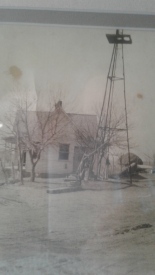
“If wishes were horses, then beggars would ride,” goes an old Scottish proverb. The beggars in this case could be those who love genealogy…right at the moment they discover an old photograph that becomes an instant treasure. The wish granted would be the ability to step into the picture and to experience the sights, sounds, smells along with those ancestors. I found such a picture five years ago when I was cleaning out my mother’s house…slipped into an envelope that had been tucked into an old, musty dresser. Since I had been purging and cleaning out for over a month, I almost threw the envelope along with other tossables in the trash. Maybe by sheer magic, the picture’s subjects called to me to pull out the contents. Why, it was a panoramic photo of a farmstead and its inhabitants. The photographer had signed and dated his work in the bottom right-hand corner just as an artist signs his masterpiece…Photo by Parratt, February 19, 1917. Later, I asked my mother the who, what, where, and why questions about the picture. Her answer was that it was Grand Storer and family on their farm in Tilden Township, Osborne County, Kansas: Grand Storer, my great grandfather. So I decided to let the magic begin…
February 19, 1917, was a bone-chilling Monday. Wash and Mina Storer had contacted the photographer from the Cozy Studio in nearby Downs to take a home portrait. Roy H. Parratt instructed them to have the family members space themselves out by their home along with prized possessions. The light of a dreary February day could be tricky so the right time of the day for taking the photograph was estimated. What if each person were to share his/her story with me?
Storer Homestead
Wash: I bought this land from my father and my older brother a few years before I married Mina in 1891. I wasn’t sure if I actually wanted to be a farmer. For the first year and a half of our marriage, we lived in Louisiana where I worked on building levees on the Mississippi River along with my uncle and cousins. This work was not for me so Mina and I along with our newborn son Roy Eugene headed back to Kansas. We lived for awhile on a farm near Mina’s parents before we came to this land. Once we settled on this property, we lived for a few years in a cave…yes, a cave where I reinforced the ceiling with stone from my quarry. Imagine that! We built a new large house and three big barns just seven years ago in 1910. Now my farm consists of 240 acres with milch cows, Holsteins, chickens, and pigs. I make most of my money from the cows…I am not a wheat farmer. Both my son Roy Eugene and daughter Myrtle Mary are married and live nearby. Our remaining six children live and work on the farm.
Mina, Leslie, Angie, Hattie
Mina: Can you imagine setting up house in a cave? Many early Kansas settlers did that, you know. Why I gave birth to my twin babies Angie and Andrew in that cave…won’t that be a story for them to tell their grandchildren some day! Being a farmer’s wife is a joy to me, and I am mighty proud of our big house. I love to invite family and neighbors over for Sunday dinners after church. Making fried chicken and mashed potatoes with white gravy is my specialty. I am also known for my sugar cookies. Yes, we also enjoy inviting neighbors to barn dances here on a Saturday night. The ladies bring special desserts. We have three neighbor men who are the musicians for square dancing. Today for this picture taking, Wash and I decided that I would drive out our Model T loaded up with our baby Leslie and my daughters Angie Pearl and Hattie Della. I asked one of my boys to crank it up for us. Don’t it beat all to have a picture taken of our little paradise!
Angie: Papa and Mama told us to gussy up for this picture…make sure our hair is done up…just as if we were meeting our beaux on a Saturday night. Hattie here, she is the one who can really fix hair. Says she wants to be a beauty operator and not a farmer’s wife. Me…my sweetheart Carl wants us to have our own farm and settle in with a little family.
Hattie: Now, it isn’t too often that our pictures are taken. We have been doing chores since sunup when we went to the hen house to gather eggs for breakfast and to help Mama get everything ready to feed the men. Also, Monday is wash day so soon we will be headed off to heat water and scrub. Yes, sir…I am counting on leaving the farm life one day and moving west…California dreaming, I am.
Wash, Marvin, Hillis, Andrew
Marvin and Hillis: Each day, we prove to our pa that we can handle this hard work. We ride out to check on cattle in the pastures. We look for broken fences. We bring cows into the barn to milk. When school is in session, we ride double to the one-room schoolhouse that we attend. Sometimes when we are riding across the fields, we talk about our dreams for the future. We would both like to see new places…explore a little. Pa likes to quote that saying, “The grass is always greener in your neighbor’s pasture.” Us…we want to see if that is true.
Andrew: Since my older brother married and has his own farm, I have been Pa’s right hand man. My hands are calloused, and there is not much time for daydreaming. Been thinking about the prospects of having my own place a few years down the road. Got a cousin who has a farm nearby that he would like to rent out…maybe, that could be me. At several of our barn dances, I noticed a little girl…she’s younger than me. Says she is going to Kansas City soon to help out her married sister. I really do not have a lot of time for courting, but I have her sister’s address so I can write her when she leaves. Understand from the paper that Europe is at war. President Wilson says that we are going to remain neutral…keeping out of it. Speculation around here is that time may tell. Been notified by the local draft board that I need to come register soon. All I really want is to stay here and hug the soil and the neck of a good horse. (Andrew winks at me as he walks away. In 32 years’ time, he will become my grandfather.)
Postscript: A copy of that panorama picture hangs in our home. It is over 100 years old and part of my legacy. The thoughts and feelings of my ancestors are just pure speculation and fantasy on my part. If only wishing could always come true…
The domino effect reverberated through the events of my 2nd great aunt’s life and that of her family. Mary A. Boultinghouse would live only 28 years, yet a ton of tragedy would envelop her and those she loved.
Mary grew up on the plains of Illinois on a farm with her parents and nine siblings. Her father was born in that state while her mother was born in France. Did her mother teach her French phrases? Her mother was skilled in needlework. Did she pass that on to Mary? Her life there would seem idyllic compared to what would be her future.
Sometime during the Civil War, she became the sweetheart of Daniel H. Warden, who was a sergeant in the 20th Illinois Infantry. He was eight years older and hailed from the county in which she lived. Did they exchange letters and a vow that they would marry upon his return? He suffered a foot and a hand wound in the Battle of Shiloh that hindered his ability to walk…yet he remained with his company. Five days after he was discharged from service, they married in DuPage County, Illinois. At some point, they moved to Chicago where he was employed as a carpenter-joiner. How did the couple struggle because of his disability?
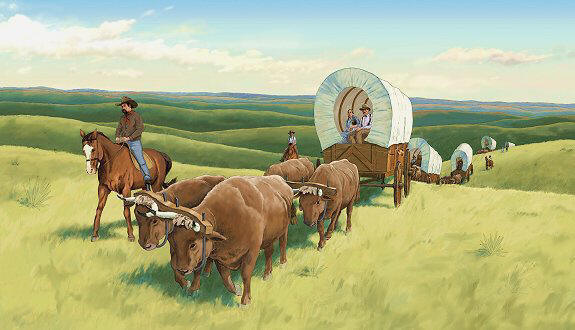
In the summer of 1871, Mary and Daniel decided to migrate to Osborne County, Kansas, where they would claim land under the auspices of the Homestead Act. They traveled by covered wagon along with Mary’s parents and siblings. Mary and Daniel were accompanied by their children Anna Laurie (age 5) and Peter Tecumseh Sherman (age 3)…sadly, their infant daughter Gertrude had died the year before. How did they manage to travel with Daniel’s disability? Life was harsh on the prairie, but they managed to build up a small homestead. Their son Walter was born within the next year. Then in 1873, tragedy struck. Daniel noticed ducks had landed on their pond, and he asked Mary to bring him his rifle. While Mary was carrying the gun, it discharged…”Oh my God, I have shot myself.” She died within moments. She was buried on her parents’ homestead. A few months later, the Warden house burned down.
Two years after her death, the tragedy in Mary’s family continued when her son Peter was bitten by a poisonous rattlesnake. He lived a few days and was buried near his mother. Daniel decided that he could no longer remain on the farm so he moved his family to Leadville, Colorado. He earned his living with his carpentry skills. At some point, he realized that he could no longer care for his children. He adopted out Anna and Walter to strangers. Anna was taken to Chicago and Walter to Kansas. All of this became too much for Daniel…he died of a gunshot wound in 1879.
As a postscript to this story: their daughter Anna Laurie lived to be almost 90 years old. She lived most of her life far from the Kansas plains in New York. In her obituary, it stated that Anna would give talks to school children about being a child during the Great Chicago Fire…that fire happened in October 1871…Anna and her family moved to Kansas in the summer of 1871. Also, she talked about witnessing Indian raids…the last recorded raid in Osborne County was in 1870. Did her imagination cover up the tragedies of her life?
Many of my ancestor great grandmothers I know only through research. My third great grandmother, Rhoda Howell, is one of those women. On paper, she is a few dates and a name in a probate journal. Who was she really? I can only assume and speculate.
I do know that Rhoda was born to Amos and Mary Howell in Tennessee. The date for that is sketchy. Her family moved to Illinois, and she met Daniel Boultinghouse. Daniel was born in Pennsylvania and had moved across to Ohio and into Illinois. He had been married twice before and was the father of 10 children, ranging in ages from 21 to nine years old. He and Rhoda married on 31 January 1813 in Gallatin County, Illinois. Rhoda gave birth to Matilda in 1814 and Amos in 1818. (Amos is my second great grandfather.) They would settle in the Fox River district of White County, Illinois. Daniel was a militia member whose chief job was to ward off Indian attacks. Daniel died in May, 1823, just ten years into the marriage. Probate records show that Daniel left no will. They also show that Rhoda appeared at the courthouse with a list of people to whom Daniel owed money, and the debts were paid. Record-wise, this is the last mention of Rhoda.
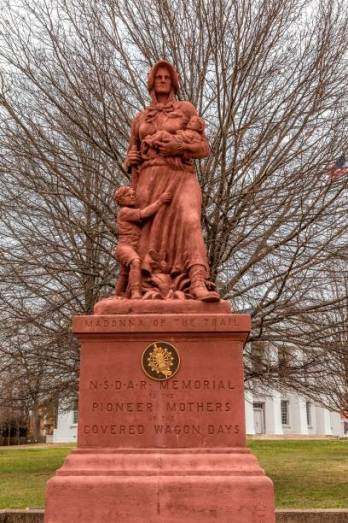
In reading about pioneer women, I discovered over and over again how harsh life was for them. Some historians tout that the women had to be stronger than the men. Certainly, this was true of Rhoda. How was she shaped and molded by life? What was it like to be married to Daniel and to raise his other children? How did widowhood change her worldly circumstances? How isolated did she feel when her husband ventured out to perform his militia duties? My educated, researched guess is that she did all she could to survive. Some of the older children had married and moved on into Arkansas and Texas. Did she stay on their farm and direct the older remaining boys in farming and hunting for food? She had her womenly tasks to perform as well as to educate the girls in housewifery. Did she turn her eyes to heaven each day to ask God to be her guide and strength? Was she sustained by faith, resiliency, and perseverance?
I wonder how Rhoda spent the remainder of her life. It is a fact that her son Amos left home at 19 to join the Army. Records show that her daughter Matilda married a Henry Whetstone, but little is found about them…no census records contain their names so tick marks can be studied for an older woman living in the household.
Rhoda Howell is a woman of unspoken strength…tested strength…enduring strength…even though there are no recorded words to give testimony to her character.
“So that is who he is,” I told myself as the mental clues gelled in my head. Throughout my childhood, I had heard my grandmother say, “Oh, she/he is related on the Stevens side.” At that age, I had no idea what those words meant nor was I curious. As I fast forward to my “genealogy years”, I was finally able to grasp an understanding and make an introduction.
I first met William when I started grafting branches to my family tree. He was a name with attached dates and places. He had a wife and nine children. He was born in England and died in Kansas. Was that the beginning and end of his story, or was there a crucial middle to his life’s tale? As writers and readers, we know that the middle of a narrative piece holds and embraces the details…genealogists learn that, too.
As I fast forward again, I was to meet live, now-to-me cousins on Ancestry. Here were gals who were related to me on the Stevens side. They held the keys to the middle part of Will’s life story along with the glorious details. They had portrait photos, wedding photos, letters, family photos of Will and his family. Through them, I met the flesh and blood William Henry Stevens, my second great grandfather.
Where there is a will would certainly be a motivational cry for young Will Stevens. He came to America in 1864 while the Civil War was still waging…an immigrant at the age of twenty-one. He had been in the British Navy. After being in New York City for six months, he joined the Union Navy. He was assigned to three different ships which were often engaged in blockading Confederate harbors. He spent much time in the crows nest and reported on what he saw. As a result of that job and being close to cannon blasts, he became deaf in one ear. He also sported alligator and cross tattoos…a fun fact for me. After the war, he made his way back to Manhattan, New York, and Jersey City, New Jersey. He worked as a laborer for the American Gas Company.
Where there is a will…a year after the war, he married his sweetheart, Isabella Anna Couchman. She, too, was an English emigrant; she was a seamstress. They lived for a time in New Jersey as their family grew. Whatever the calling and attraction, the family moved to Memphis, Tennessee. Again, he chose work with a gas company. After the war, Memphis was a place of unrest and Reconstruction change. Did Will and his family feel that? Is that one of the factors that led him to the next family move?
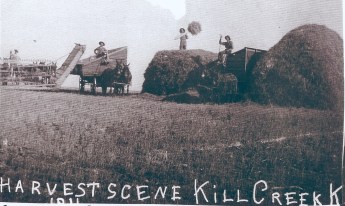
Where there is a will…President Lincoln and Congress’ Homestead Act enabled settlers to gain free land in the Midwest. Will accepted that invitation when he claimed land in Kill Creek Township, Osborne County, Kansas, in 1872. I wonder what he knew about farming…an English emigrant, sailor, former resident of four major cities, gas company employee. He came to Kansas by himself and settled in a dugout on his property. A year later, the rest of his family followed. Besides a strong will, what other virtues guided and strengthened him? Did his family feel isolated out on the farm? How did he learn to plow and sweat under the harsh plains’ sun? Did he hunt and fish to feed this family? Buffalo were hunted by early Kansas settlers…were he and his sons hunters…city boys? A family story revolves around Indians coming to their farm and stealing baby clothes from a trunk…clothes surely made by seamstress Isabella’s hands. Strong willed people often possess resiliency and perseverance; surely, Will carried these qualities in his soul, mind, and heart. Were these passed along to his children…and to me? The value of hard work flowed through his veins. Family talk has it that he was a man of few words. But was he a man of many thoughts and feelings?
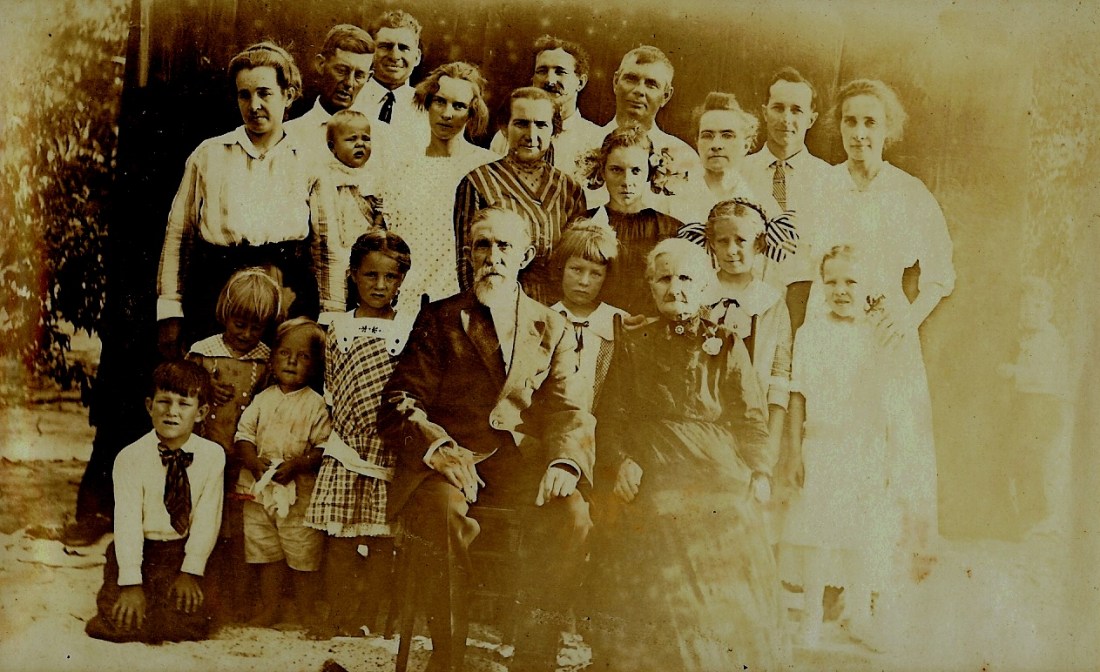
Where there is a will…Will lived 83 years which is lengthy for a Civil War veteran. In 1916, he and his beloved Isabella celebrated their 50th wedding anniversary. One of the treasures shared by my new cousins is this picture taken at that party. What joy the couple must have experienced when surrounded by their children and grandchildren! Where there is a will, a man wraps strength and serenity in his familial arms.
Post Script: My grandmother, Isabella Mary Boultinghouse (named after her grandmother), is to the right of the woman in the striped dress in the center of the photograph. Yes, she is the one with the flowery hairdo.
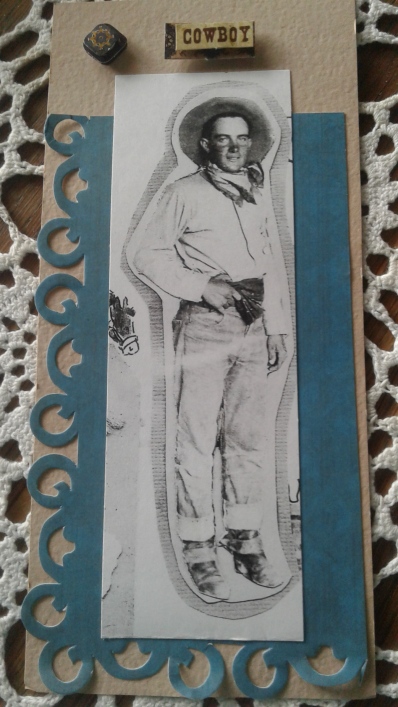
Sometimes, Kansas farm boys hear the call of wayward wind voices directing them to new horizons. At the beginning of the last century, my great uncle Edward “Jack” Ralph Boultinghouse heard those voices. He followed them to the vastness of Wyoming cattle ranches and to booming oil fields where purple mountain majesties embraced him. He has been introduced to this land when he came with his father on a hunting trip in 1916. His father returned to Kansas…Jack stayed. He became a real cowboy who could wrangle and rope. Eventually, he became a roustabout on those oil fields.
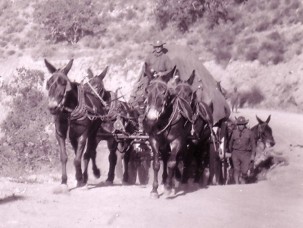
Along that journey, he joined the Wyoming National Guard. The United States was drawn into World War I in 1917 despite all of President Wilson’s actions to maintain our neutrality. Suddenly, Jack the bronco buster became Jack the wagoner. His military unit was the 116th Ammunition Train, 41st Division. He lead mules and horses that pulled wagonloads of artillery rounds to cannons in battle zones.
His unit was formed from men from Wyoming and Oregon. These men were chosen to be wagoners because of their experiences with handling horses and mules. The Brits and the French were quite happy to have these Yanks join them in the fight. World War I would be the last war to use horses and mules…the Yanks had lots of these animals to lend to the fight.
Jack and his company left for France on December 12, 1917, aboard the commercial steamer Antigone. How did it feel to be crowded on a ship with a vast ocean before him…how did he compare that ocean to his beloved Grand Tetons? Did he suffer both seasickness and homesickness?
Once in France, he was responsible for caring for his team of mules and driving a wagonload of ammunition. What did that sound like as caravans of teams moved forward through dirt and mud? How did the soldiers’ voices boom out with commands for the animals? When were the days most frightful as the distant thunder of battle filled the air? Did Jack write letters home to reassure his family that he was safe…his hometown paper carried little news of the war?
After the Armistice was signed on 11 November 1918, Jack and his unit remained in France until 24 June 1919. How did his unit spend their days after the war? Was there a somber mood or a celebratory air as they sailed home? How did he envision his future?
After his return, Jack did go back to Kansas for a brief time. Those wayward wind voices called him to return to his beloved Wyoming. Throughout the remainder of his life, he would also live in Nebraska and Colorado…working as a wildlife preserve manager and as an Army consultant for Remington Arms.
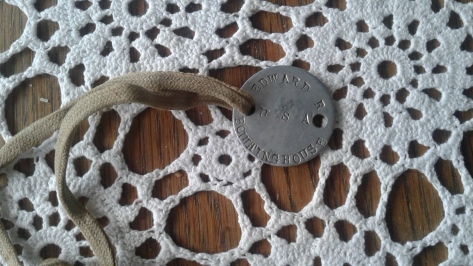
My grandmother, Isabella Mary Boultinghouse, was Jack’s little sister as he was seven years older. How she came to receive his World War I dog tags I do not know. Did he give them to her when he returned from war? How they were passed onto me I do not remember. This little aluminum disk is a precious heirloom to me…it once hugged the neck of my real cowboy and soldier Uncle Jack.



 After the land and homes were ravaged, the survivors set to work raking and burning. What else could they do to rid themselves of the pestilence? What good would come from this? That year’s crops, fruits, vegetables were gone. Would some of the settlers stay to face the future, and would some flee to begin again elsewhere?
 No, y’all, we do not have any family stories about taxes, such as the time Grandma Scarlett told Miss Mammy to tear the velveteen curtains off the wall so that they could be made in a dress that would make Grandpa Rhett, who was in jail, agree to pay the county taxes on Tara. No, m’am…no, sir. What we do have are times that ancestors might have thought, “This just taxes me to no end. As God is my witness, I will never be hungry again.”
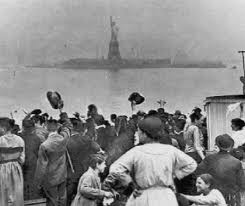 In 1906 and 1912, she was the basis of the welcoming committee for my grandparents. Hers was the first face they saw in America…this grand lady who embraced them and called them forward. Committed to serving and enlightening, she welcomed my father’s family to her shores. Thank you, Lady Liberty.


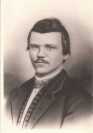 Sometime during the Civil War, she became the sweetheart of Daniel H. Warden, who was a sergeant in the 20th Illinois Infantry. He was eight years older and hailed from the county in which she lived. Did they exchange letters and a vow that they would marry upon his return? He suffered a foot and a hand wound in the Battle of Shiloh that hindered his ability to walk…yet he remained with his company. Five days after he was discharged from service, they married in DuPage County, Illinois. At some point, they moved to Chicago where he was employed as a carpenter-joiner. How did the couple struggle because of his disability?
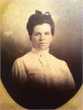 As a postscript to this story: their daughter Anna Laurie lived to be almost 90 years old. She lived most of her life far from the Kansas plains in New York. In her obituary, it stated that Anna would give talks to school children about being a child during the Great Chicago Fire…that fire happened in October 1871…Anna and her family moved to Kansas in the summer of 1871. Also, she talked about witnessing Indian raids…the last recorded raid in Osborne County was in 1870. Did her imagination cover up the tragedies of her life?
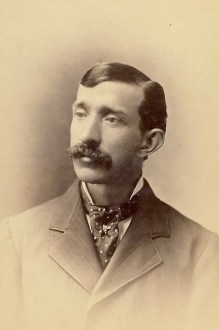
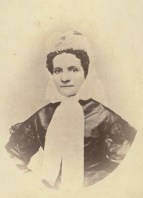 Where there is a will…a year after the war, he married his sweetheart, Isabella Anna Couchman. She, too, was an English emigrant; she was a seamstress. They lived for a time in New Jersey as their family grew. Whatever the calling and attraction, the family moved to Memphis, Tennessee. Again, he chose work with a gas company. After the war, Memphis was a place of unrest and Reconstruction change. Did Will and his family feel that? Is that one of the factors that led him to the next family move?