52 Ancestors In 52 Weeks: Changing Names

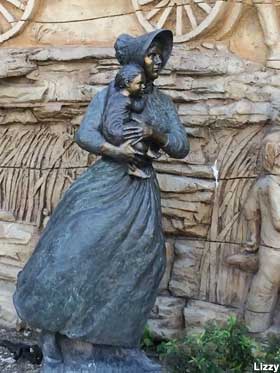
Pioneer Mom and Baby: Located in Shawnee, Kansas

In the book of Isaiah, it is written, ” I have called you by name, and you are mine.” She would be called several different names during her lifetime. Born on the first day of spring in 1828, Maria Magdalina Kraemer was French; however, her part of France was often claimed by Germany. She bore a German name. She spoke French.

Family stories reveal that Maria was educated in a convent school, where she learned the domestic art of doing fine work embroidery. Somehow, sometime, she came to Manhattan in New York. No record of her parents or means of passage can be found for Maria. It is there that she Anglicized her name…she would be called Mary.

At the age of 14, she met U.S. Army private Amos Howell Boultinghouse. He was from Illinois but stationed at Fort Columbus, New York, near Manhattan. Somehow, sometime, they met and agreed to marry. He was ten years her senior. On her marriage license application, she listed her first name as Mary from Alsace, France. She lied about her age and stated she was 22 years old. (She would not need a guardian to sign off on her marriage as she claimed to be an adult.) She was now called Mary Boultinghouse.

After a time, the couple moved to Amos’ native Illinois, where they farmed and began a family. Mrs. Boultinghouse would give birth to ten children. She would be called “Mother”. During the couple’s 18th year of marriage, Amos reenlisted in the Army during the Civil War to serve in the Union’s 55th Illinois Regiment. At times, Mary was referred to as “Sergeant Boultinghouse’s Mrs.”. Together, she and her children tended the farm during Amos’ three year absence.

In 1870, the Boultinghouses decided to take advantage of the Homestead Act. They came by wagon to Osborne County, Kansas. Walking to Kansas, Mary was pregnant with her 11th child. A few days after arriving, she gave birth to her son in a tent. He was the first white male born in the county. The baby was named after Mary’s favorite French hero, Lafayette. Neighbors and townspeople would refer to her as “Mrs. B”.

As Mary aged, the townspeople called her Grandma B. She was considered the matriarch of a pioneer family and a revered citizen. Amos went home to the Lord in 1893 while Mary lived until 1901. They were buried side by side in a small cemetery. She had been called home by the Lord. I call her second great grandmother…treasured and revered.

52 Ancestors In 52 Days: Heirlooms

A precious gem resting in a gift box of a valley…punctuated by low mountains…it was presented to me 50 years ago. I have held it tenderly in my care and even more so now. It is an heirloom.

I grew up in a small hometown also nestled into a valley. At a young age, I had migrated to this place. I knew the charms, elegance of a small town. I knew all the places to love. As a young woman, though, I had yet to become acquainted with all of its secret nuances. I needed experiences through the years to bring the revelation of its exquisiteness to me.

My husband Daniel presented this heirloom of his hometown to me in April, 1974, as a first wedding anniversary present. We were relocating here to an apartment so he could be closer to his job. A few months later, I would gain a position as a teacher at a small Catholic school. Through the years, I learned more about the part his family had played here from employment at a machine shop to the establishment of the fire company. They had roots here along with hometown pride.

In September, 2021, my beloved Daniel went home to God. Often, people would ask me if I was going to stay here. My response, “Dan gave me his hometown as a gift to love. So, I shall.” The gift of a family heirloom has a name…Waynesboro, Franklin County, Pennsylvania.

Credit: John Briggs Photography

52 Ancestors In 52 Weeks: Immigration

His name appeared like a shooting star across the sky. Then, he fizzled out of sight on the horizon. I had found my grandfather’s older brother as he disappeared into the mist in front of a brick wall.

A cousin alerted me that our grandfather’s brother, Josef Slabik, appeared in a marriage license application in the records of Manchester, Hillsborough County, New Hampshire. He also could be found in a birth record for his daughter. So, the search was on.

As a 21 year old, Josef married a fellow Polish immigrant Karolyna Makar on 21 October 1902. He was a weaver at the Amoskeag Textile Mill in that New Hampshire town. In researching the mill, it was one of the largest in the world at the turn of the century. Advertisements were placed in European newspapers to call workers to America. Were these ads Josef’s calling card to a new life from being a serf in his home country?

In October, 1905, Josef and Karolyna welcomed their first child, daughter Maryanna. Her birth certificate was located.

Then, the brick wall stands between me and the rest of the details of their lives. No appearances in passenger lists, censuses, city directories, town records. Vanished…unknown…no paper trail to their lives. I could just shake those branches of my family tree in frustration. The paternal side of my tree is this side of barren.

What was found did tell me of my grandfather’s older brother who came before him to America. My immigrant grandfather never spoke of his family. So, these facts became little diamonds in the rough. Perhaps, another day more can be found about Joseph, Karolyna, and Maryanna.

a

52 Ancestors In 52 Weeks: Earning A Living

October, 1732             Ipswich, Essex County, British Colony of Massachusetts

As my life draws to an end, I think of all I was to all of my people. I have been asked to relate how I made my living as a family man, as a citizen of the British Colony, as a citizen of the Kingdom of God. And so, I will share my story.

As a family man, I was faithful husband to Elizabeth and our eight children. One might give my job description as a yeoman. I was a freeholder of my farm land. The hard work of my family took care of the land and fed us. Life was hard…life was unpredictable…life was heavy. We kept our eye on the Lord to steady us.

As a citizen of the British Colony of Massachusetts, I took up arms in King Philip’s War. King Philip was the name we gave to the Native American Wampanoag chief Metacom. This took place in 1675. The chief and his people would not recognize our British authority and would not recognize our intent to claim more lands as our own. So, the fighting began. I was a witness to its violence.

As a citizen of the Kingdom of God, I was a deacon in my church in Chebacco Parish. The parish formed as the community of the Second Church of Ipswich. My duties included caring for widows and orphans, overseeing financial matters, and cooperating with other deacons and the pastor. This church formed the lives of myself and my family.

And so, as I leave this Earthly life, I ask the Almighty to judge me as He may.

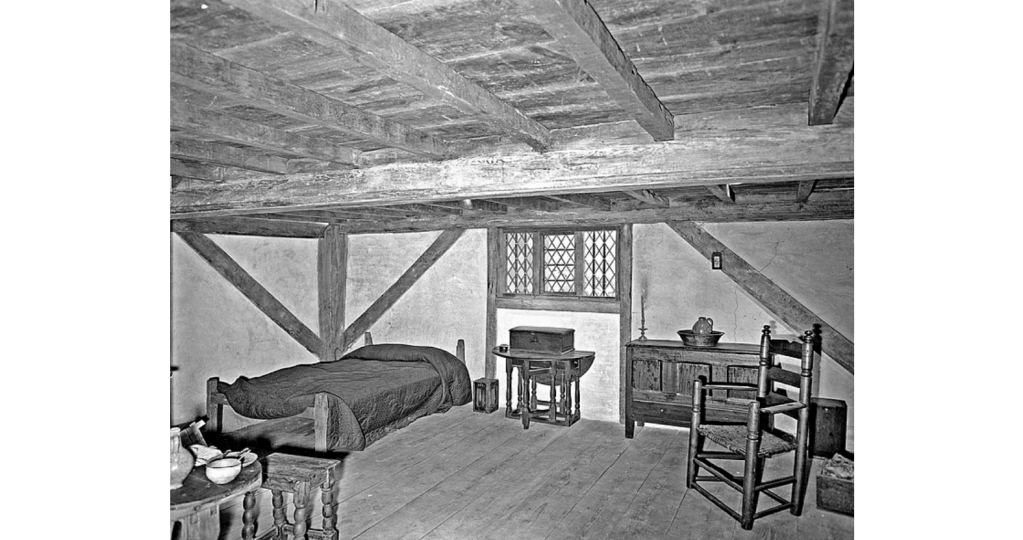
Note: Seth Story and Elizabeth are my 7th great grandparents. A section of their home in Ipswich is on display in the Smithsonian in the American History Museum.

52 Ancestors In 52 Weeks: Influencer

As an elementary teacher, I dedicated much of my career to the creating lifelong readers and writers. I had a unique way of viewing the integration of these two literacy areas. Reading and writing existed together as one body, not separated parts of the whole. And so my journey began…

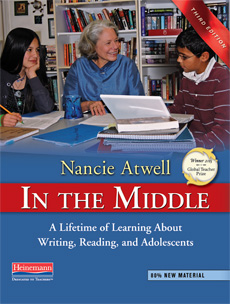
In 1995, I came across a nationally known language arts teacher named Nancie Atwell. Her book In The Middle was speaking directly to me. She got me as I did her. She understood the new direction I was taking in my Language Arts teaching. We spoke the same language! What a relief to know that I was not standing alone. I became even more passionate about teaching.

In meeting up with Nancie, she opened the door to other influencers…Lucy Calkins, Regie Routman, Katie Ray Wood. Through their influences, my teaching was making me more empowered. Then, there were childhood literature writers who were igniting my world and lighting fires in my students’ lives: Kate DiCamillo, Beverly Cleary, Avi, Cynthia Rylant.

So, one little fire that was set by an influencer, Nancie Atwell, ignited into a passion for literature and writing. Thank you, Nancie, for starting that fire.