52 Ancestors In 52 Weeks: Witness To History

Amos Howell Boultinghouse         25 April 1865

I much admired the man. He stood as a lover of this country and its ideals. I had known of him early in his political career as we both lived in Illinois. I was born and raised here, but I had spent five years away when I served in the U.S. Army from 1838-1843. I understand that he hailed from Kentucky, but his heart had grown fond of the people of Springfield, the capital city. So I felt a kinship for him.

At the age of 43, I got a calling…a call to return to the military. My fellow Illinoisan was now the President of the United States. First, he asked for 75,000 troops on 15 April 1861. Second, I joined up with men from Dupage County to serve in the 55th Illinois Infantry to meet his call. We needed to preserve the Union. I would be serving as a wagoner since I had had much experience in the care of horses.

Many an evening, the men in my company would sit around the campfire. Maybe just telling stories about family and home. Maybe just creating stories about adventures. Maybe just wondering how old Uncle Abe was going to pick the next Commanding General. Maybe just how we were going to win this war.

I had enlisted for three years, and my time was up in April 1864. I was now 46 years old…quite an old guy who needed to head back home to his family and his farm. The war could not last much longer.

The news did not take long to travel…it was unbelievable, unfathomable, unreal. The President had been shot and died on 15 April 1865. It was just 4 years since his call for troops. What would happen now to the nation?

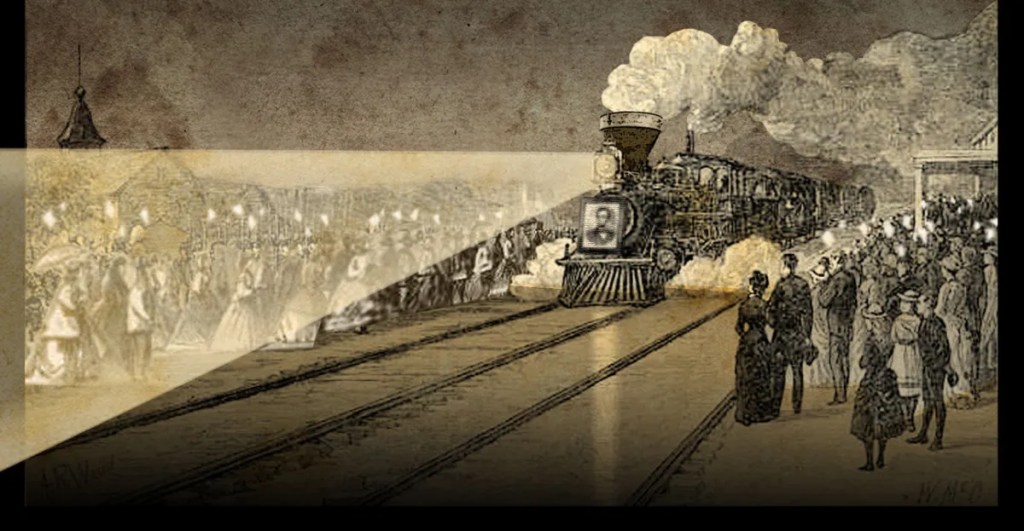
News is also coming that a funeral train will wind through major railroad cities. Thousands will salute Mr. Lincoln on his way back home to his beloved Springfield. My heart will follow that train as I salute my Commander-in-Chief on his way home. May God save us and the Union.

~Amos H. Boultinghouse  55th Illinois Infantry, Company E
52 Ancestors In 52 Weeks: Origins

What were the origins of her thoughts? What was the catalyst for this line of thinking? How did it all start?

1906…a Polish orphan girl has no possibilities…she is 14 years old. Where can she go? What will become of her? She and a small group of her friends get an idea. Each of them has brothers who have gone to America. Is it at all possible to go where their brothers live? Anna Mroz thinks she has found a solution.

The group of girls makes a plan. They will travel from their home in Jastrzebiec. With guidance from their brothers who instruct them through letters, they will get tickets for passage from Trieste, Italy, to New York, New York. This first part of their journey from Poland to Italy is more than 800 miles. How much of that journey will be on foot and how much by train? What will it cost each of them?

Safely arriving in Trieste, the group of five girls is ready to take passage on 30 April on the ship Georgia, which will accommodate 350 passengers in steerage. When passage was booked, Anna lied about her age. She says she is 16. They arrive in New York City on 24 May 1906. For more than three weeks, she and her girlhood friends have battled seasickness, uncertainty, anxiety. Perhaps, one of their first sights as they see the skyline of the city is the figure of Lady Liberty. Does her presence ease some of their fears? Then, there are the various stations to pass through at Ellis Island. Eventually, her brother Antoni will meet her before they leave for Connecticut. What will come next?

Origins of thought, origins of family and country, origins of a new life…so how did this start an adolescent thinking, planning, hoping? My grandmother…Anna Mroz.

52 Ancestors In 52 Weeks: Favorite Photo

Asking me to pick a favorite photo, brings out this question to me: in what category? For what topic? On my genealogical journey, this picture to me is one of the best. It is the results of patience, steadfastness, and perseverance.

It started in 2007 when I was searching for my paternal grandfather’s name in the Ellis Island Records. He was not there. I had been told by my aunt, his daughter, that he came in 1912. Searching through pages and pages of documents, I kept looking for the elusive Franciszek Slabik. After a three year search, one Sunday morning, I said, “Frank, I am going to find you today. This is your day.” He was from Poland, but it was a time that Poland was not recognized as a country. I looked with an open mind. Bingo…there he was.

In Polish, the letter L can has a slash through it. In transcribing the records, the transcriber had written STABIK. He listed his country as Austria with Polish as his language. The town I know that he was from was listed. Bingo…

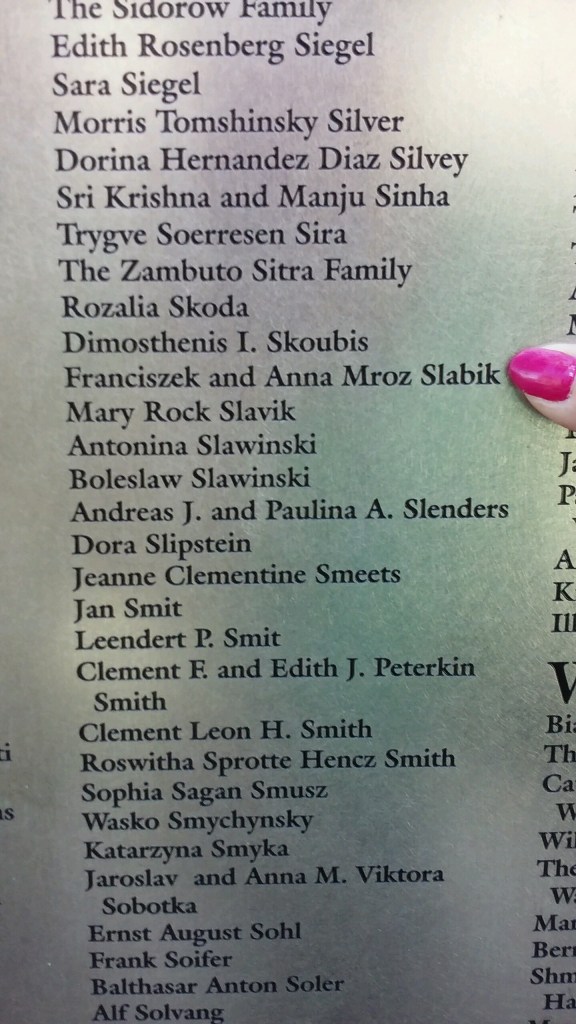
In 2017, I chose to have his name along with my grandmother’s name (immigrated to America in 1906) inscribed on the Wall of Honor at Ellis Island. Their names appear on Panel 761. Along with my husband Dan, we made a pilgrimage there…to breathe the air they breathed, to see what they saw when they arrived.

Why it this a favorite? It is a tribute to my grandparents. It is in honor of the granddaughter who never gave up looking for them. It is a beginning of an American story.

52 Ancestors In 52 Weeks: Family Lore

Just who was she? Why was she hiding in the background? Had she not had a life before meeting up with him? The family did not have much to tell about her as they did her husband. Oh, he was the source of tales, sagas, and downright family lore. So, just who was she?

Born in 1833, Mary Etta Soule grew up in a small hamlet in New York. Surrounded by water and forests, she lived among family, aunts, uncles, and cousins. For her first fourteen years, this was her way of life. Then the early death of her father left the family wondering how they would survive.

Her mother Jane was a strong willed woman who had little fear of anything. She gathered her young sons and daughter to make a new life. Part of their journey westward took them down the Erie Canal. Mary Etta and her family group went by steamer across Lakes Erie, Huron, and Michigan to Milwaukee. From there, they traveled by grain wagon to Watertown, Wisconsin. She was now eighteen and for awhile worked in a brickyard. She struck up a friendship with the manager, Andrew Storer. He needed a wife to care for the animals on his small farm so he proposed. Did they marry for love?

With her new husband Andrew, she discovered that she had married a man with wanderlust. He was originally from Maine with quite a background, too, in settling in different places. In time, they would settle in the Minnesota Territory, Iowa, and finally Kansas. Together they would raise nine children. Mary Etta became known for her steadfastness, loyalty, and familial devotion. She passed after a brief illness in 1887 at the age of 54.

Later, it was noted in the newspaper that Andrew had erected a memorial to Mary on his farm. Being one of Osborne County, Kansas’s earliest pioneer families, more is told and remembered about Andrew. Mary Etta remains a quiet figure without any family lore…sometimes, those persons are the foundation and backbone of those who are best remembered.