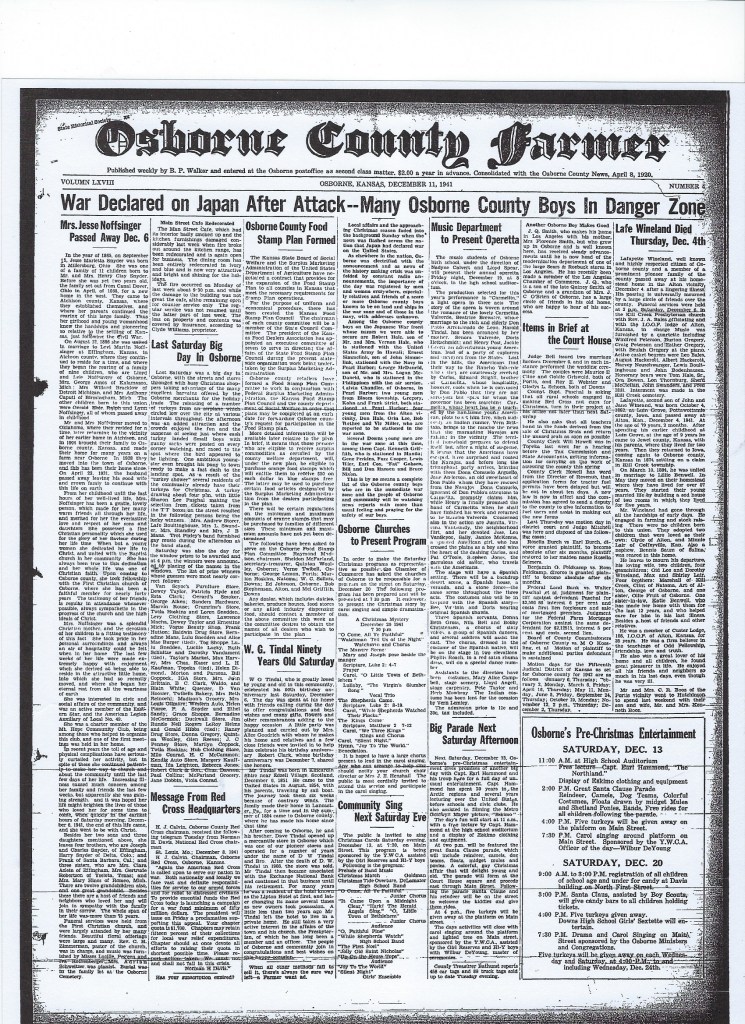
52 Ancestors In 52 Weeks: In The News

Thursday, December 11, 1941

Man In The Street Reaction: Andrew E. Storer, age 45 years old, farmer, Alton, Kansas

“I heard neighbors talking, partyline conversations, meeting friends at the general store…some heard President Roosevelt on the radio as he spoke out about ‘the day of infamy’. Boys will be called up to fight just as I was in 1918. Back then, it was called The Great War…The World To End All Wars. Did the taste of it really end wars? No, now war is in Europe and the Pacific. County boys will respond with loyalty to the freedom of the Stars and Stripes. May God protect them!

Girl In The Street Reaction: Merna Mae Storer, age 17 years old, high school senior, Alton, Kansas

“The school hallways are buzzing with the voices of the boys who are enlisting after graduation. They greet each other with ‘See you in Tokyo!’ As for me, I have been planning on leaving the farm and heading to the state capital in Topeka. As this point, I do not know how war will affect my plans. I might be needed at my parents’ farm. Graduation is six months off so… How can I help? What will I be called to do?”

On this December day, the county citizens’ opinions, thoughts, and prayers varied. They listened to radios at home or at their neighbors hungry for news and reports. They trusted their national and state leaders to guide them forward into the unknown abyss of another war. Little did they know that it would end four years later with many county boys giving their lives for freedom.

Note: Andrew E. Storer is my grandfather who served in World War I. Merna Mae Storer is my mother who after high school worked at the State Capitol Building in Topeka. In that city, she would meet her future husband, Edward J. Slabik, who came for Army training in Topeka.

52 Ancestors In 52 Weeks: Birthdays

September 24, 1900: Birthday Surprise on Mrs. James Nickel

It seemed that husband Jim was going to pull off the perfect surprise for his wife Mary Emily. It was her 50th birthday, and a big afternoon was planned. Jim was being secretive. He invited family and neighbors to come for a surprise supper for his wife of 29 years. Would he get away with it?

Through word of mouth, invitations went out. Guests were asked to bring a dish to share plus bring their own plates and eating utensils. Daughter Almina was baking a cake to bring. They were to assemble at noon. So when vehicles began to arrive, Mary Emily gasped in surprise at the company. “Jim Nickel, what have you done?” she questioned. “Nawthin'”, was his response.

All the little details of the day were reported by the small weekly Kansas county newspaper, The Osborne County Farmer. Such a little event merited eight paragraphs. As was typical of the social event reporting of the day, the article touted the couple as “good people and have raised a good family and made a good home.”

James Nickel and Mary Emily Weaver are my second great grandparents. I never heard anyone speak of them. I first met them in a county history book. In investigating their lives, I used that same county newspaper to flesh them out as real people. Amazingly, little social gathering details were reported in that newspaper. I was able to meet them and get to know them. They were pioneers who first came to Osborne County, Kansas, with their family in 1878. Jim was from Pennsylvania while Mary Emily was from Ohio. And so, a little surprise birthday party became an avenue of making their acquaintances.

Cherished Forever

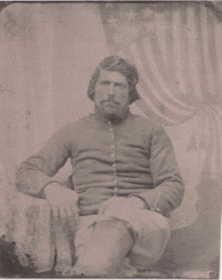
The warm breezes across the farm fields whispered his name…”Abel, gone, gone”. It was the summer of 1864. Eliza Ann had to hold the family together because her beloved Abel was not coming back. As she looked across the Franklin County, Maine, fields, she could hardly hold back the tears of grief. Such sadness for one heart to hold!

He was 20 years old, and she was 17 when they married. In the 18 years of their marriage, they parented 8 children. The land they farmed could hardly support them as they relied on charity. So why did he enlist in the 2nd Maine Cavalry in January, 1864? Was the cause calling him to action?

Before he left, he has his likeness taken. Proud in his uniform. Proud of his military contribution to county. Proud of his heritage dating back to his ancestors of the Revolutionary War. Proud to be in the cavalry. He was going far from home to help protect a city he knew little about, but he had been called to serve.

Abel was stationed near New Orleans to protect the city. Beginning in April, 1864, he had complained of heart pain and asked to be placed in the field hospital. The Army surgeon diagnosed him with rheumatism and placed him back on duty. On May 26, when his regiment was leaving the city, Abel fell from his horse and died. He had endocarditis, a heart condition. He was buried in Louisiana.

Back in Maine, Eliza Ann received word of her Abel’s death…gone in Louisiana. She wasn’t sure where that was. Buried…she wasn’t sure where. Never to see him again…how would she survive?

Through time, Eliza Ann took in boarders to support the family. She applied for a widow’s pension which was granted in 1865 in the amount of $8/month. She never remarried and lived 43 years without him. Did she ever journey to his burial place so far from home?

Note: In looking over my tree, I first noted Abel’s Civil War likeness and his death date. I became curious as to his story. In researching him, I found these facts about him. He lies buried in Chalmette, Louisiana, National Cemetery. Did Eliza Ann ever get to visit his resting place?